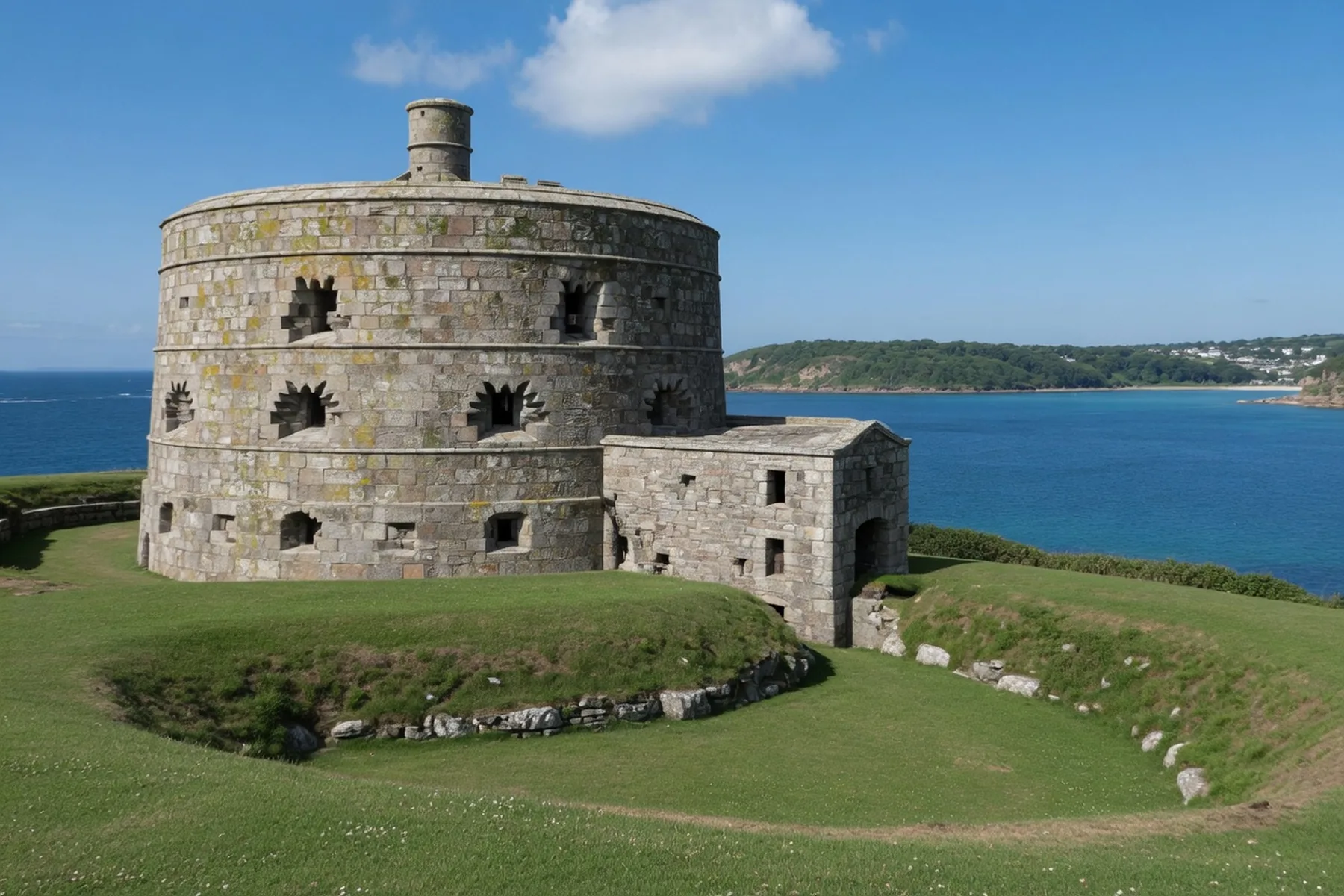
Pendennis Castle sits on the headland that makes Falmouth possible. The Carrick Roads — a drowned river valley deep enough to hold a fleet — opens behind it, the Channel in front, and for four hundred years the job of the fort was to stop anyone who was not invited from using either.
It is English Heritage, it is the town’s most-reviewed sight, and it is larger than the round keep you see from the water suggests. Allow the afternoon.
Henry VIII broke with Rome and then expected France and the Holy Roman Empire to do something about it. The Device programme of the 1540s was the response: a chain of artillery forts along the south coast, built to fire at ships rather than to survive a medieval siege. Pendennis and St Mawes, on the opposite shore, were a pair, covering the mouth of the Fal between 1540 and 1542.
The original work is the circular keep and the gun platform below it — a squat granite tower with gun ports looking to sea. At the end of the century, with Spain the threat after the Armada, the keep was wrapped in a ring of stone ramparts and angular bastions in the Italian manner. That is what gives the site its size, and what makes a visit take two or three hours rather than forty minutes.
Start at the keep. The gun deck, the displays of arms and the climb onto the roof are the Tudor core, and the view from the top is the one that explains the rest of the town: docks to the left, beaches to the right, St Mawes straight across the water.
Then walk the ramparts. The circuit is the Elizabethan enlargement, and it is the bit visitors underestimate. There are magazines, a guardhouse with cells, and enough climbing that anyone who treated this as a quick look at a round tower will be on the site longer than they planned.
The Half Moon Battery holds First World War guns and was still operational in 1956, which is the fact that usually stops people. Pendennis was a working coastal battery from the Tudors to the Cold War, not a ruin that happens to have a café.
Below it, the Second World War underground command post is the part visitors call the most atmospheric — concrete, cramped, and a different century from the keep. If you only go into one interior besides the tower, make it this.
The Victorian barracks and the shop and café sit in the middle of the circuit. Use them; the site is exposed and the wind off the Channel is real even in August.
In 1646 Pendennis was one of the last two Royalist strongholds left in England. The garrison, under Sir John Arundell — in his eighties — held for five months against siege by land and blockade by sea, and marched out with colours flying when the food ran out. Only Raglan lasted longer.
The interpretation on site tells this properly, which is not true of every English Heritage castle of this size. Read it before you walk the ramparts: the ground makes more sense once you know it was defended against English armies as well as foreign ships.
The ticketed castle is only part of the headland. Pendennis Point below is open, free, and the better place for a sunset or a flask. Old gun batteries, benches, and the whole of the harbour mouth: this is where locals come when they do not want to pay to go inside.
Castle Beach sits at the bottom of the same hill. At low tide it is one of the best rock-pool systems in south Cornwall; at high tide it is a small cove. If you are doing both, check the tide and do the beach first or last, not in the middle of the castle visit. See our beaches guide and the Castle Beach page.
Parking on the headland is free at both the castle and Pendennis Head. That is not true of anywhere useful in the town, so if the castle is the day’s main aim, drive straight here — see parking in Falmouth.
The two forts were built as a pair and they are still best understood as one. The St Mawes ferry from the Prince of Wales Pier crosses in about twenty minutes, with Pendennis on one beam and St Mawes Castle ahead. St Mawes is smaller, clover-leaf in plan, and a different afternoon: village, castle, pubs, ferry back.
Doing both in a day is the classic Falmouth outing and it is entirely on public transport once you have reached the pier. English Heritage membership covers both. See the St Mawes Castle page and our boat trips guide.
Admission is charged; free to English Heritage members. Advance online tickets are cheaper than the gate. Members still need the card.
Hours change with the season. In the main summer months the site has been opening daily from 10am with last entry an hour before closing; winter is shorter and some weekdays close. Check the English Heritage listing for the day you are going, particularly on a Saturday, when events sometimes take the keep.
Time. Two to three hours for the castle, more if you add the point and the beach. Reviewers who “popped in” regret it.
Getting there. A twenty-five-minute uphill walk from the centre, or a shorter one from Falmouth Docks station at the foot of the hill. There is a 20 per cent discount if you arrive by train, bus or bike and show the ticket or the helmet — one of the few Cornish attractions that actually rewards not driving.
Access. The grounds are large and sloping. The keep and the battery mean stairs. It is not a level site.
Facilities. Café, shop, toilets. Events, open-air theatre and re-enactments run through the season; Falmouth Week in August puts extra pressure on parking even up here.
Dogs. On leads in the grounds; not in the indoor displays. Check the current rule if that decides the day.
Park on the headland. Walk the point first, while you still have the legs, then go into the castle. Keep, ramparts, Half Moon Battery, underground post, café. Drop to Castle Beach if the tide is out. Back into town on foot or by the town bus, and if there is anything left in the day, the St Mawes ferry.
That is the castle as a visit rather than a photograph from the water, which is what most people settle for and then wish they had not.
Henry VIII, between 1540 and 1542, as part of the Device programme of coastal artillery forts. St Mawes was built at the same time on the other side of the harbour.
Two to three hours inside the castle, plus time on the point and at Castle Beach if you want them.
Not unless you are an English Heritage member. The point below the castle is free, and the views from there are a fair taste of the paid ones.
Yes — it is the small fort directly across the water. The ferry from town is how you visit it.
The interiors — keep, barracks, underground post — hold a wet morning. The ramparts do not. Pair it with the Maritime Museum if the day is truly poor; see Falmouth in the rain.