Helston is a town of 11,611 people at the 2021 census, at the northern end of the Lizard Peninsula, and the most southerly town on the island of Great Britain — around 1½ miles (2.4 km) farther south than Penzance. It is a market town rather than a coastal one: no harbour, no seafront, and the sea a walk away down a river valley, shut off behind a bar of shingle.
That walk is one of the two reasons to come here from Falmouth. The other is a date: on 8 May the town dances the Furry Dance through its streets and through the insides of its buildings. The rest of the year it is a working town of shops, a museum and a cinema — the way onto the Lizard rather than a day out in itself.
The straight-line distance from Falmouth is 15.5 km.
Below the town is Coronation Park, 4.6 from 120 Google reviews, with a man-made lake where rowing boats can be hired in summer. Across the road is the Penrose Amenity Area, once part of the Penrose Estate and now National Trust land, with walks beside the River Cober down to Loe Pool and the sea beyond Loe Bar; a bird hide off the main path looks over the pool.
Loe Pool is Cornwall’s largest natural lake, and it exists because the river lost its mouth: rising sea levels after the last ice age threw a barrier beach across the Cober. The bar is mostly flint, whose nearest source lies offshore, under the drowned terraces of the former river that ran between England and France.
Penrose carries 4.7 from 612 Google reviews, and reviewers name the practical things: café, toilets, car parking, dogs allowed. A visitor in June 2026 called it a “Great place to go for a peaceful bike ride with kids. Its got a cafe and gardens in the route too,” and gave it three stars.
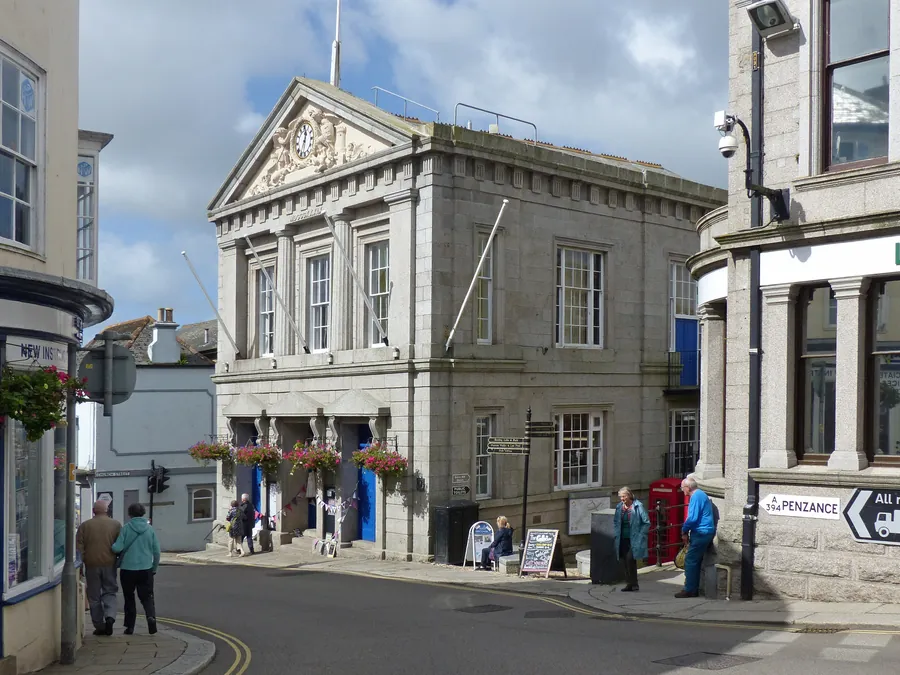
The Museum of Cornish Life, 4.7 from 533 Google reviews, was founded in 1949 and occupies the town’s Market House of 1837, built as two buildings, one for butter and eggs, the other the meat market. Its exhibits are mostly the town’s agricultural and market past. It is bigger inside than it looks: a visitor in July 2026 wrote, “another museum that looks small on the outside and is like a tardis on the inside.” Mind where you leave the car — a visitor in July 2026 wrote, “Could have spent a lot longer had i not parked in a half hour bay.”
At the end of Coinagehall Street stands the Grylls Monument, 4.4 from 53 Google reviews, raised by public subscription in 1834 to thank Humphry Millet Grylls, a local banker who stopped the closure of Wheal Vor, a mine then employing over a thousand people. Near it a bowling green occupies the site of Helston Castle, built in 1280 for Edmund, Earl of Cornwall, and fallen into ruin by 1478. One former draw has gone: The Flambards Experience, the old Helston Aero Park, closed in 2024 as visitor numbers fell away after COVID.
RNAS Culdrose lies about a mile south-east of the town centre, and opinion on its public viewing area, 4.4 from 477 Google reviews, divides. A visitor in June 2026 wrote, “Excellent views. Quiet day today, but still things going on.” A visitor in July 2026 was angry: “The viewing area has been RUINED. They have changed the fencing so your camera will not focus beyond it and a large red sign says any photographs or recordings are not allowed.”
Flora Day falls on 8 May, unless that is a Sunday or a Monday — Monday being market day — when it moves to the preceding Saturday. Four Furry Dances run through the day: the first, historically for domestic servants; a mid-morning dance by children from the town’s schools, all in white; the midday dance, in ballgowns and full morning dress; and a late-afternoon dance for the town’s tradespeople, who go round twice.
Only Helston-born people may dance in the lead set, and the first man and woman lead only once in their lives. Helston Town Band accompanies all four dances on a long route, houses and shops are hung with bluebells, campions and greenery, and the dances pass through private buildings, shops and grounds rather than round them. The same morning brings the Hal an Tow, a rowdier piece of street theatre of apparent medieval origin and still changing: its most recent verse, about St Piran, appeared only in the 21st century.
The name comes from the Cornish hen lys, “old court”, with “ton” added later for a Saxon manor; Domesday records it as Henliston. King John granted the charter on 15 April 1201 for forty marks of silver. Tin ingots were weighed here to fix the coinage duty owed to the Duke of Cornwall, which is what Coinagehall Street is named for.
Whether Helston was ever a port is disputed. Daniel Defoe wrote in 1725 that the River Cober “makes a tolerable good harbour”, but Loe Pool is named in a document of 1302, implying the bar already existed; Gweek, not Helston, was the recognised port; and no customs records or archaeological evidence for a port here survive. A plan drawn up in 1837 to open Loe Pool to shipping behind a pier was never carried out.
Helston lies on the A394. North-east, that road runs to Penryn, where it meets the A39 down into Falmouth.
Buses have changed recently. First Kernow’s U4 between Penzance station and Falmouth ended when the operator ceased operations in Cornwall on 14 February 2026. Go Cornwall Bus has replaced it with services 2 and 2A from Penzance station to Helston and Mullion School, and service 3 from Helston to Falmouth.
There is no station here. The Helston branch line ran 8.5 miles (13.7 km) south from Gwinear Road, near Hayle, and closed in the early 1960s; the Helston Railway Preservation Company is restoring part of it. The nearest station is Redruth on the Cornish Main Line, served by Great Western Railway between London Paddington and Penzance. Bike hire is at this end: Lakeside Cycles on Porthleven Road, 16.0 km from Falmouth, 5.0 from 133 Google reviews.
The village and what is around it, at walking scale.
Open any of them in Google Maps for directions and current opening.
Attractions, prices and availability in Falmouth
These come from GetYourGuide's booking widget, which sets their cookies in your browser. Consent to load it and see the attractions and prices.
Background on Helston draws on its Wikipedia article, text there being available under CC BY-SA 4.0.