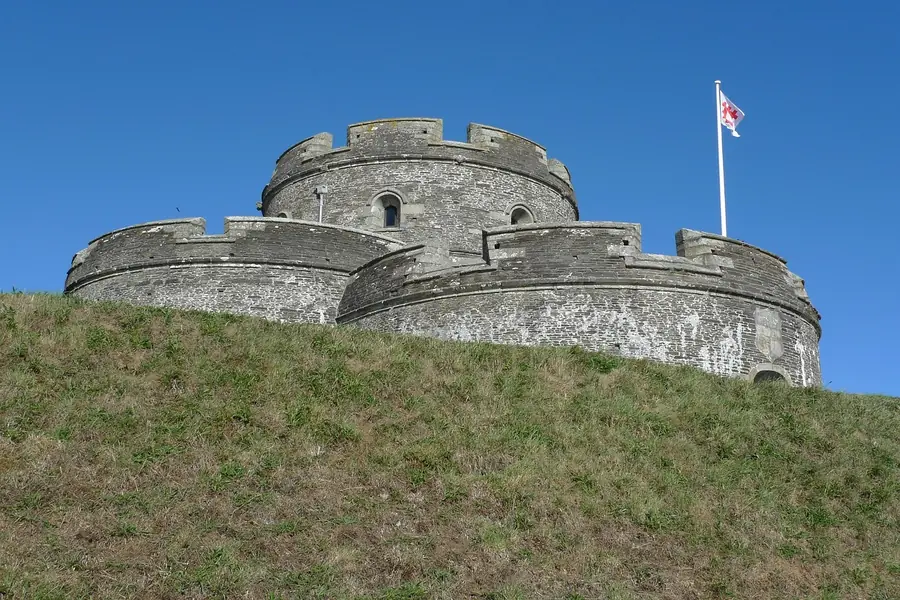
St Mawes Castle — Kastel Lannvowsedh — sits on the Roseland Peninsula directly across the Carrick Roads from Falmouth, and it is the twin of Pendennis: built at the same time, between 1540 and 1542, under the same Device programme, to cross fire with it over the entrance to the anchorage.
It is the better-looking of the pair and the smaller. Where Pendennis grew into a fortress, St Mawes stayed essentially as Henry VIII built it, which makes it the most complete and least altered of all the Device forts.
Built under the direction of Thomas Treffry to a clover-leaf plan: a four-storey circular central tower with three round bastions projecting from it, each a gun platform, arranged so that fire could be brought to bear across a wide arc of water.
It is decorated, unusually for a gun fort — carved Latin inscriptions run round the exterior in praise of Henry VIII and Edward, gargoyles at the parapet, and coats of arms. That combination of heavy artillery and Renaissance ornament is what makes it worth crossing the water for.
The weakness is the position: it sits on a slope with higher ground behind it, and it was designed only to fight ships. When Parliamentary forces arrived by land in 1646, the garrison surrendered without resistance — while Pendennis, across the water, held for five months.
It stayed in service intermittently into the twentieth century, with gun batteries added below.
Visitors are divided about the admission price, and the split is predictable. It is small. There are four storeys of the tower, the bastions, some furnished rooms and a gun deck, and you can go round it in forty-five minutes to an hour.
What you are paying for is the completeness of the thing, the carving, and the view — out over the Carrick Roads to Pendennis, with the whole anchorage in between. The subtropical garden on the slope below is a genuine pleasure and is included.
If you come by ferry from Falmouth as part of a day on the Roseland, it is a good hour well spent. If you drive over specifically and expect a large castle, you may not think so, and some visitors have said as much.
By ferry is the right way: the St Mawes passenger ferry from Prince of Wales Pier in Falmouth takes about twenty minutes and lands in the village, from which the castle is a ten-minute walk along the shore.
By road, it is a long way round the estuary — about forty minutes. And the local warning is real: the car parks are poorly signposted from Upper Castle Road, and drivers who miss them end up in a narrow lane dropping steeply into St Mawes village. Watch for the signs early.
Admission charged; free to English Heritage members.
Time: forty-five minutes to an hour, longer with the garden.
Facilities: a shop, and a coffee van at the car park. Toilets.
Access: the tower is four storeys of spiral stair and is not accessible; the garden and outer terrace are more manageable, and the view from the top of the site is available without going down.
St Mawes village — harbour, waterside cafés, narrow streets, and views back across to Falmouth.
St Just in Roseland, five minutes north, has one of the most beautiful churchyards in England, a sub-tropical garden falling into a tidal creek.
Place Ferry across the Percuil River gives access to the Roseland coast path and St Anthony Head.
St Mawes is smaller, more ornate and almost unaltered since 1542. Pendennis grew into a large fortress and has far more to walk round.
By passenger ferry from Prince of Wales Pier, about twenty minutes, then a ten-minute walk. By road it is about forty minutes round the estuary.
Forty-five minutes to an hour, plus the garden.
If you are already on the Roseland or arriving by ferry, yes. Visitors who drive over expecting a large castle sometimes find it small for the price.
No — the garrison surrendered without resistance in 1646 because the fort was designed only to fire on ships and was overlooked from the land.