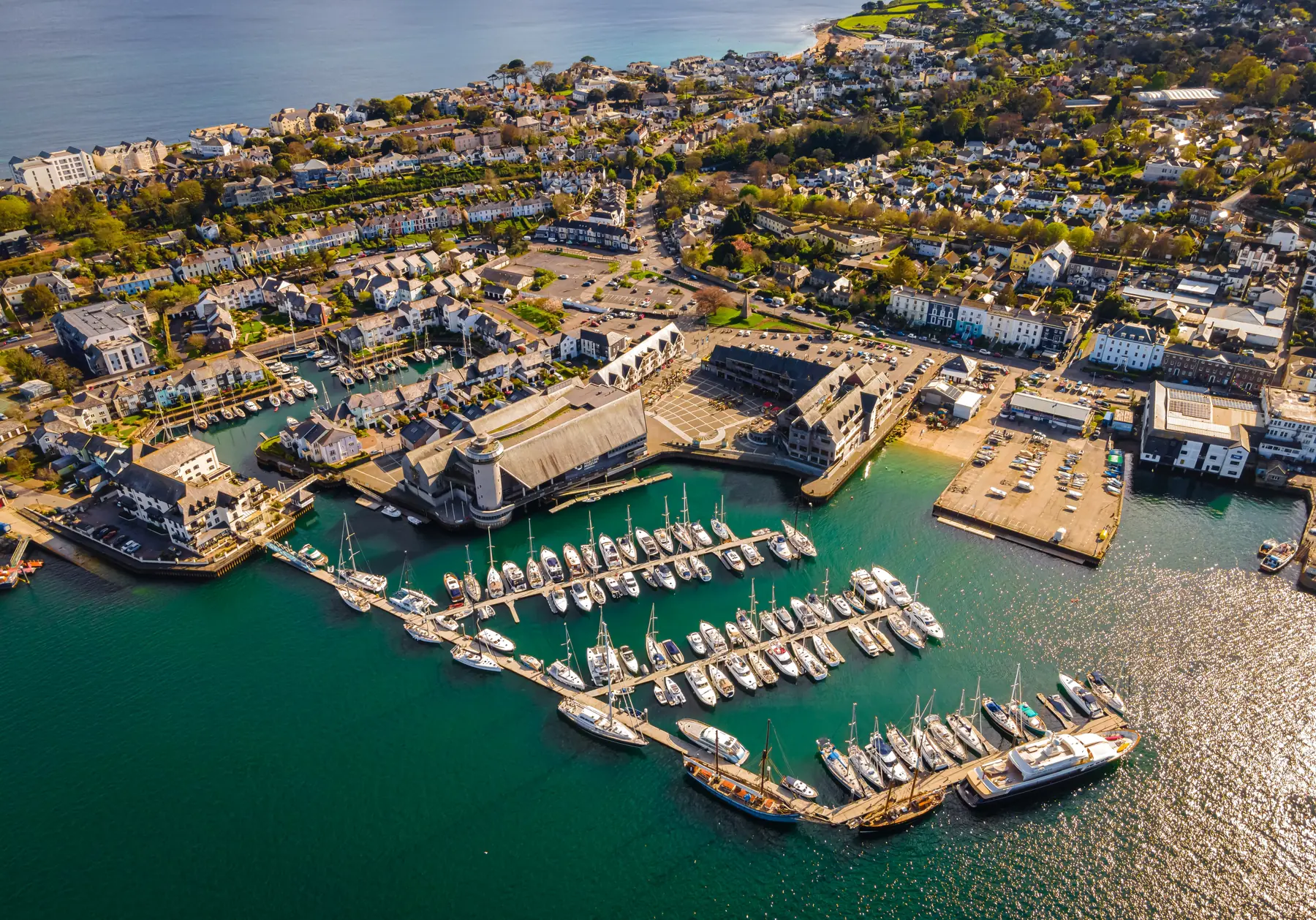
Cornwall is wet. The peninsula sticks out into the Atlantic and takes whatever the ocean sends, and any honest Falmouth guide has to admit that a week here without rain would be a good week rather than a normal one. The town is used to it, and it has an unusual concentration of indoor options for its size — a national museum, a free art gallery, a two-hundred-year-old arts institution, a university’s worth of galleries and studios, and a great many pubs.
There is also a specific Cornish point worth making early: the subtropical gardens are better in rain. Tree ferns, gunnera and mosses want humidity, and Trebah and Glendurgan in drizzle look like what they are pretending to be.
On the harbourside, purpose-built, and the reason a wet week in Falmouth is not a problem. The main hall hangs small boats at every level from the floor to the roof; below sea level there is a tidal zone with windows into the harbour water; above, a tower gives a view over the whole port. The displays cover navigation, boatbuilding, shipwreck and Cornwall’s maritime history, and there is usually a major temporary exhibition.
Two to three hours, longer with children, and tickets often allow repeat entry over a period — useful if the forecast is bad all week.
Free, in the Municipal Buildings on The Moor, and much more substantial than most town galleries: one of the leading collections in Cornwall and the south-west, with old masters, major Victorian painters, maritime art and a strong holding of British illustration. It also runs an active family programme. An hour, and it costs nothing.
The Royal Cornwall Polytechnic Society, founded in 1833, still operating on Church Street as an arts centre with a cinema, gallery and events programme. It is one of the oldest institutions of its kind in the country and the building alone is worth going into.
Falmouth’s art school is one of the best known in Britain and the town is full of the consequences — small galleries, studios, exhibitions and a level of visual culture that a town of this size would not otherwise have. A number of spaces are free to walk into.
The Cabinet of Folklore on the High Street is a tiny museum of Cornish folklore, superstition and witchcraft. It is odd, it is cheap and it takes about forty minutes, which is exactly the right length for a shower.
Kernow Escape on Market Street runs escape rooms and suits teenagers and groups.
Raze the Roof at Penryn, three kilometres away, is the soft-play answer with younger children.
Pendennis Castle is more sheltered than an artillery fort sounds: the Tudor keep, the Second World War tunnels and the guardhouse displays are all indoors, and the site is English Heritage with a decent café. It is a fair wet-day option, though the ramparts are exposed.
St Mawes Castle across the water is smaller and more compact, and the ferry over is covered — arriving somewhere by boat in the rain has a certain amount going for it.
This is the Cornish trick. Trebah and Glendurgan, both above the Helford River about six kilometres out, are subtropical valley gardens full of tree ferns, bamboo, gunnera and rhododendron. They are humid places by design and they look their best under cloud and drizzle. Both have cafés, both have a beach at the bottom of the valley, and both are far quieter in poor weather.
The same applies to Kennall Vale, the wooded gunpowder-works ruin north of the town, where the waterfalls need rain to be worth seeing.
Truro, twenty minutes by train, has the cathedral, the Royal Cornwall Museum and covered shopping — the obvious wet-day escape.
The Eden Project near St Austell, around forty-five minutes by road, is the definitive Cornish rainy-day destination: the whole point is that you are inside a biome.
The Lost Gardens of Heligan are on the same run and are more outdoor.
Helston, sixteen kilometres, has the Museum of Cornish Life, and the Flambards theme park nearby has substantial indoor sections.
The town beaches and the surfaced path linking Gyllyngvase, Castle and Swanpool are short enough to abandon and are bracing rather than miserable in a squall. Pendennis Point takes twenty minutes. And the woodland reserves — Kennall Vale, Devichoys, Tregoniggie, Carwinion — all have tree cover.
Avoid the exposed sections of the coast path towards the Lizard in a gale, and check the ferries: crossings are cancelled in rough weather, which can strand a walk on the wrong side of the harbour.
Ferries stop in bad weather and run reduced or no service in winter. Do not plan a return leg around one without checking.
Parking free at Town Quarry, Well Lane, Pendennis Head and Pendennis Castle; the Park and Float at Penryn is weather-dependent for obvious reasons.
Trains to Truro run every half hour or so from three stations in the town, which makes the wet-day escape easy without a car.
Seasonal closing. The gardens, several attractions and many of the boat operators close or reduce hours from November to March.
The shape that works here: Maritime Museum from opening until early afternoon, which is three hours indoors and the best of them; lunch on Arwenack Street or Market Street, five minutes away; then either the art gallery on The Moor, which is free and takes an hour, or the drive out to Trebah or Glendurgan, which are genuinely better in rain and much quieter. Finish in a harbour pub watching the weather come up the Carrick Roads.
If the rain is set in for the week, the train to Truro and on to the Eden Project is the escape — the biomes are the definitive Cornish wet-day answer, and the whole run is doable without a car.
Two things are worth knowing. The first is that Cornwall’s weather moves fast: the peninsula is narrow and Atlantic systems cross it quickly, so a morning of rain frequently gives way to a clear afternoon. Waiting an hour is often a better plan than driving somewhere.
The second is that the south coast and the north coast are different. Falmouth is on the sheltered side, in the lee of the Lizard, and it is milder, sunnier and calmer than Newquay or St Ives on the same day. When the north coast is being battered, the Carrick Roads can be flat.
That is also why the subtropical gardens are here rather than there. Frost is rare, the growing season is long, and plants that would not survive a Midlands winter grow into trees in these valleys.
Falmouth’s main street runs for the best part of a mile along the harbour and is lined with independent shops, galleries and cafés, which makes it an unusually good street to be caught out on. The Poly on Church Street has a café and a cinema; the art gallery on The Moor is free to walk into and has somewhere to sit; and the harbour pubs are old, low-ceilinged and built for exactly this.
The Maritime Museum also has a café that does not require a museum ticket, and a view over the harbour that is worth an hour in itself when the weather is coming in from the south-west.
The National Maritime Museum first, the free art gallery second, and the subtropical gardens at Trebah and Glendurgan, which are better in the wet.
Yes, entry is free.
Yes, and its tickets often allow repeat visits over a period, which makes it better value on a wet week.
Cornwall is one of the wetter parts of England, though the south coast is milder and sunnier than the north coast and the moors.
In light rain, generally yes; in wind and rough water, no. Check before relying on a return crossing.