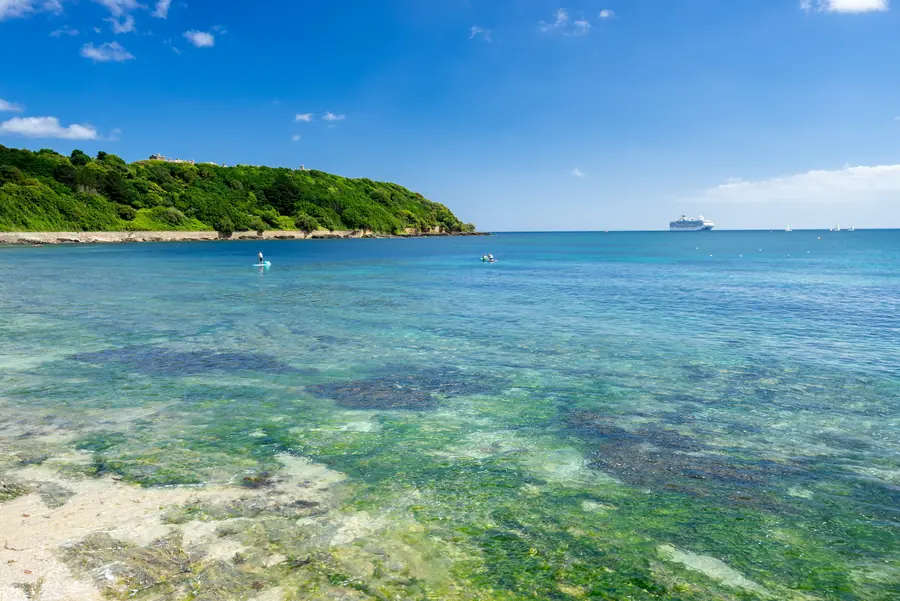
Castle Beach lies under the western flank of the Pendennis headland, and it is the closest beach to Falmouth’s town centre — about ten minutes’ walk, and five minutes east along the front from Gyllyngvase.
It is not a sunbathing beach in the way Gylly is. It is predominantly a wave-cut rocky reef with patches of sand between, and its reputation rests on what is under the water rather than on the sand above it.
This is one of the best and most accessible snorkelling spots in Cornwall.
The reef, the gullies and the kelp hold a lot of life — wrasse, blennies, gobies, spider crabs, prawns, cuttlefish in season, and occasionally something better. The water is sheltered by Pendennis Point and by the shape of Falmouth Bay, so conditions are usually calm except in a southerly wind, and visibility is often good.
There is an established local snorkelling culture here, and it is one of the more genuinely rewarding things you can do in Falmouth with a mask and a pair of fins.
Rock pooling at low water is likewise excellent and is a better bet with young children than swimming.
Castle Beach largely disappears at high tide. This is the single most useful thing to know about it, and visitors who arrive at high water without checking are consistently disappointed — what was a beach is water against rocks.
Go at low or falling tide. Then the reef, the pools and the sand are all exposed and the beach is at its best.
There are also rocks and boulders in the shallows, which make walking in awkward. Wetsuit boots or old trainers are a real help.
There is no lifeguard and no surf rescue cover at Castle Beach. Gyllyngvase, five minutes west, is patrolled in season.
That, plus the rocks and the tide, means this is a beach for competent swimmers and for supervised paddling and pooling rather than for unsupervised children in the water.
Access is by a slope or steps from Cliff Road above, where there is on-street parking and a bus service.
Facilities: a café with covered outdoor seating above the beach, and public toilets.
Dogs are not permitted — this catches out visitors who assumed the smaller beach would be the relaxed one. Swanpool, west of Gyllyngvase, allows dogs all year.
Best time: low tide, and a settled day with no southerly wind.
Pendennis Point, ten minutes east round the headland, with free parking, benches and the old battery.
Pendennis Castle above.
Gyllyngvase Beach, five minutes west, is the lifeguarded family beach with the full run of facilities.
Castle Drive, the level coast walk that links all of them.
Only in patches. It is mainly wave-cut rocky reef with sand between, which is what makes it good for snorkelling.
No. Gyllyngvase, five minutes away, is patrolled in season.
At low or falling tide — the beach largely disappears at high water.
No. Swanpool Beach allows dogs all year.
Yes, above the beach with covered outdoor seating, and public toilets alongside.