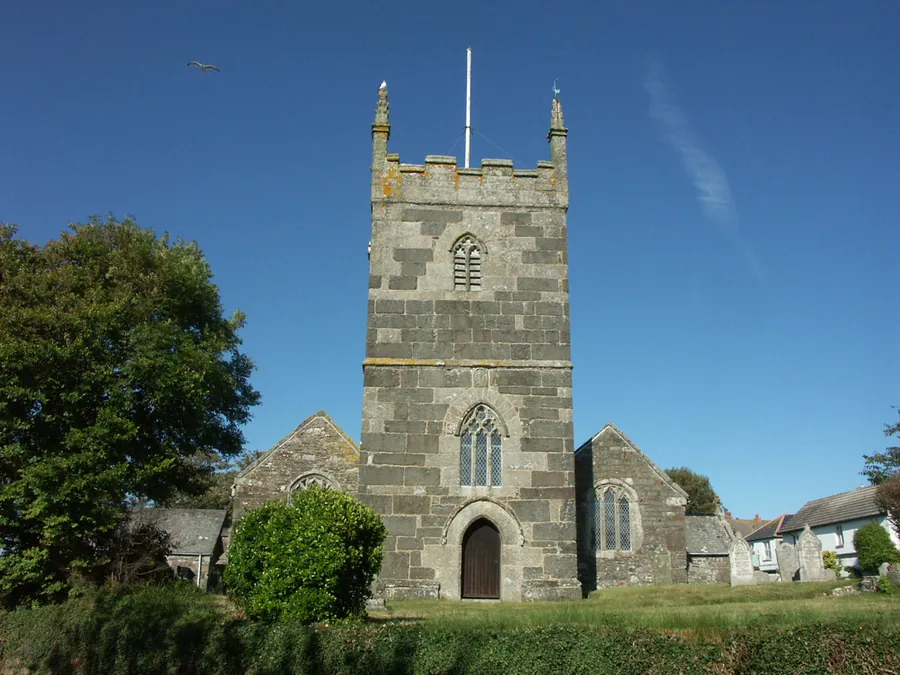
Mullion is the largest village on the Lizard Peninsula, and it is not on the coast. It sits about a mile (2 km) inland at roughly 65 metres above sea level, at the head of two river valleys that run southwest and descend steeply to the sea at Polurrian Cove and Mullion Cove. A third valley north of the village meets the sea at Poldhu Cove. The village proper, Mullion Churchtown, is the service centre for this end of the Lizard, with a secondary school and three churches.
That geography sets the shape of a visit. You do not arrive at the sea; you choose a valley, walk down and walk back up. Which cove you pick decides the day: a small stone harbour under cliffs, a wide sandy beach with a café above it, or something quieter in between.
The straight-line distance from Falmouth is 18.6 km. The parish lies within the Cornwall National Landscape, contains three Sites of Special Scientific Interest and much of the Lizard National Nature Reserve, and the South West Coast Path runs along the cliffs on its western edge.
Mullion Cove is the anchor of the trip and by far the most-reviewed place in the parish: 4.7 from 2,004 Google reviews. The harbour is listed separately at 4.6 from 25 reviews and Mullion Islands at 4.5 from 15, samples too small to lean on.
Half a mile (0.8 km) offshore lies Mullion Island, uninhabited, owned by the National Trust and home to large colonies of seabirds — something to look at from the cliffs rather than a destination. In the cove itself an adit survives from the parish’s short-lived copper mining.
The water is the draw. A visitor in July 2026 wrote, “Cracking little spot for swimming, snorkeling etc. We saw plenty fish about including a big Ballan Wrasse.”
The practical facts are the parking and the hill, and reviewers cover both. One in June 2026 reported, “Absolutely loved it here no narrow lanes ample parking in the first and maybe about 20 or so cars in the second one which is an honesty box payment,” and added, “The walk down from here toke around 10mins and about 15 or so back up the hill. Toilets as you enter the village.” The descent is the easy half.
Mullion Cove Hotel carries 4.6 from 581 Google reviews, and its reviewers are not unanimous: a one-star review in July 2026 concerned a lodge at its coastal retreat the writer found had not been cleaned properly. A July 2026 visitor dining there described a barman “checking both the weather and wind speed were suitable for outside dining”, which tells you how exposed this coast is.
Poldhu Cove is the sandy alternative, 4.7 from 124 Google reviews, with its own car park listed at 4.7 from 80. Poldhu Beach Cafe & Shop above it holds 4.6 from 486 reviews and comes with a caveat from a visitor in June 2026: “There is very little cover and no inside seating so not a wet weather venue.”
Polurrian Beach, at the foot of the other southwest valley, is 4.7 from 210 reviews, with no visitor comment in the research pack to go with it.
Gunwalloe Church Cove Beach is listed among the things to see here and is the best-rated of them, 4.8 from 673 reviews, though it lies over the boundary: the river reaching the sea at Poldhu divides Mullion from the parish of Gunwalloe. A visitor in August 2026 described “a sandy beach with lifeguards in the summer holidays”, and one in July 2026 recorded “soft sand in the water and onshore” along with a restriction worth knowing before you set out: “Dogs are not allowed.” A visitor in June 2026 warned that at the National Trust car park “the 5G signal is very poor and you can’t use cash”.
Mullion Cove was a seining station. Companies formed from the 18th century worked pilchards out of the cove with seine nets, posting a huer, or lookout, on Mullion Island to watch for the dark patch of a shoal; the catch was cured at Newlyn and exported to Mediterranean countries. A few boats still work a small shellfish industry.
The coast took ships steadily: in the six years up to 1873 there were nine wrecks along a mile-and-a-half stretch beneath Mullion cliffs, with the loss of sixty-nine lives. The RNLI stationed a lifeboat at Mullion Cove in 1867 and withdrew it in 1908. The boathouse has been demolished, but its barometer is on display in the village.
The other industries were smaller. Copper mining here was insignificant compared with the rest of Cornwall and had ceased by the end of the 19th century, though a native copper sheet found at Wheal Unity in 1847, weighing over 700 kg, went to the 1851 Great Exhibition in London. Talc quarried at Soapy Cove during the 18th century went to Benjamin Lund in Bristol for early porcelain, a business the Worcester Porcelain Manufacturers took over in 1752.
Poldhu carries the parish’s one world-changing event: in 1901 Marconi sent a wireless signal from there to St John’s, Newfoundland. The Marconi Centre marks it, 4.6 from 147 Google reviews.
The parish church of St Mellanus is named for Saint Melaine, the Breton Bishop of Rennes who supposedly took office in 519. Part of the chancel rebuilt before 1331 remains, most of the rest is 15th century, and the bench ends are the feature usually singled out.
Assume you are driving. The research pack ties no bus route and no rail service to Mullion, so nothing here establishes a way of arriving without a car. Falmouth’s own buses leave from The Moor, 0.6 km from the centre, but no service from those stops is linked to this village.
Cycling is possible but not gentle. Falmouth has no cycle shop of its own; the nearest rental is Lakeside Cycles at Helston, 16.0 km from the town centre. Falmouth is hilly, and the Lizard valleys are steeper still.
On foot, the South West Coast Path runs the western edge of the parish, linking Mullion Cove, Polurrian and Poldhu along the clifftop and continuing south past Predannack Downs towards Kynance Cove. That is the route that makes sense of the place: the coves only connect properly along the top.
The village and what is around it, at walking scale.
Open any of them in Google Maps for directions and current opening.
Attractions, prices and availability in Falmouth
These come from GetYourGuide's booking widget, which sets their cookies in your browser. Consent to load it and see the attractions and prices.
Background on Mullion draws on its Wikipedia article, text there being available under CC BY-SA 4.0.