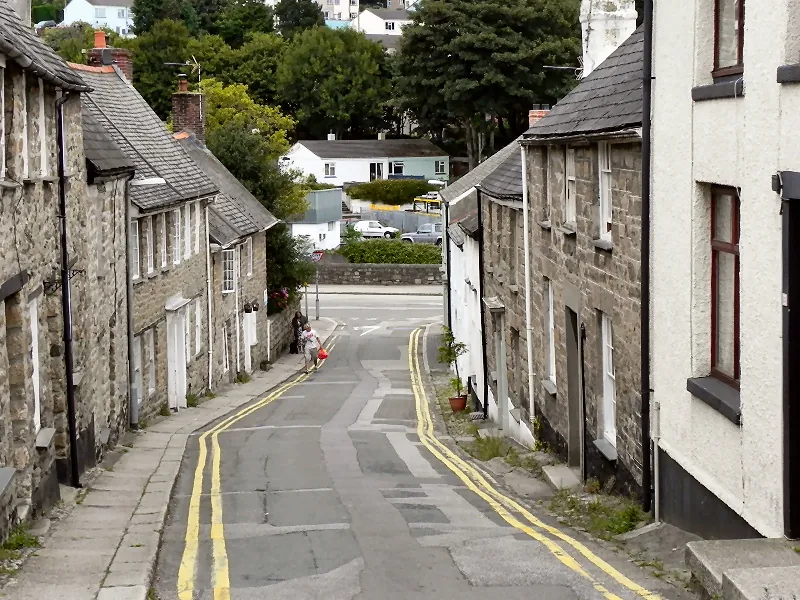
Penryn is a town of 8,489 people at the 2021 census (11,195 across the wider built-up area) standing at the head of the Penryn River, the creek that runs down into Falmouth harbour. The name is Cornish, Pennrynn, meaning promontory. It is the older of the two towns and for centuries it was the more important: a harbour in its own right, loading granite and tin for shipping around the country and abroad in the medieval period. Falmouth took the trade, and Penryn now sits in the shadow of its larger neighbour.
That is the reason to make the trip. Because the town went quiet it kept its fabric: a large proportion of its buildings date from Tudor, Jacobean and Georgian times, and it is designated a conservation area on the strength of them. It is a working town rather than a resort, with a waterfront of yards and workshops instead of a promenade, and what people come for — a garden, a small museum, a donkey sanctuary — is scattered around it.
Penryn about 1 mile (1.6 km) northwest of Falmouth. Measured from the Falmouth town centre the straight-line distance is 3.4 km, the station 3.8 km; the two towns effectively run into one another.
Penryn Town Hall is partly 17th-century and partly 19th-century, with a clock tower dated 1839, and the local museum is housed inside it. Penryn Museum carries 4.7 from 27 Google reviews, too small a sample to weigh: this is the town’s own collection rather than a day out. The parish church, St Gluvias, parts of it 15th-century, stands about 0.25 miles (400 m) north of the centre, cut off from the town by one of the arms of the river.
The waterfront is the newer half: Jubilee Wharf, a mixed-use development, went up in 2007, the former storage unit Jubilee Warehouse was renovated as workspace, and a regeneration scheme for Commercial Road went to consultation in 2022. Muddy Beach, a restaurant on the water, holds 4.6 from 825 Google reviews and is the most-reviewed place to eat here; a visitor in June 2026 wrote of “a lovely breakfast with my friend on their beautiful terrace by the water”.
The town also carries a student population: the Penryn Campus, completed in 2004, houses the University of Exeter and the Camborne School of Mines alongside Falmouth University departments.
Enys Gardens is the strongest single draw here, 4.7 from 493 Google reviews, and the bluebells fix the season. A visitor in May 2026 wrote, “The gardens are great, especially when the bluebells are blooming.” Outside bluebell season you see trees and planting rather than the display the reviews are built on.
The tea shop comes up repeatedly and warmly. So does a caveat: the same reviewer, who rated the place four stars, added that “on 2 of our visits we have felt the car park staff and/or the staff working in the small cafe have been a bit rude when we are asking questions”. One voice against a high average, but the only repeated complaint in the pack.
The Flicka Foundation Donkey Sanctuary is the best-rated place here, 4.9 from 1,076 Google reviews, and the reviews are unusually consistent. A visitor in August 2026 wrote, “It’s free entry with donations I even adopted a donkey for my husband.”
Raze the Roof, an indoor family entertainment centre, is the divided one, 4.3 from 341 Google reviews. Those who liked it liked the food as much as the play; a visitor in June 2026 wrote, “Really great place to take the kids, the food was surprisingly good.” Two run the other way: one reviewer that month objected to the cost of admission for a one-year-old and the absence of an annual pass, and another left when an adult group with additional needs was using the play area alongside babies and toddlers, writing, “I think it’s great they offer this, however not when there are babies and children using the play area.”
The town appears in the Domesday Book as Trelivel, and was founded and named Penryn in 1216 by the Bishop of Exeter; its Charter of Incorporation followed in 1236. In 1265 Glasney College was built here so the bishop could extend the church’s reach into the far west of his diocese; it was demolished in 1548 under Edward VI, a dissolution that helped trigger the Prayer Book Rebellion of 1549.
The port was significant by the 15th century, sheltered at the head of its river. Its other reputation was less respectable: the royal charter of 1621 was granted mainly as an attempt by the crown to cure the town of piracy, and at least three mayors were convicted of it between 1550 and 1650. Peter Mundy, born about 1600 to a local pilchard trader, was among the first Europeans to taste tea and came home to write Itinerarium Mundi, one of the earliest travel guides in English.
The decisive turn came in the 1640s. The port was thriving on Cornish fish, tin and copper, but Penryn backed Parliament in the Civil War and lost its custom house and market rights to the new town of Falmouth as a direct result. Granite kept it working: works were established by the river in the early 19th century and stone was shipped from the quays for building projects in Britain and overseas.
The train is the simple answer. Penryn station, opened by the Cornwall Railway on 24 August 1863, sits towards the northwest end of the town and is served by the regular Truro–Falmouth trains on the Maritime Line — the same branch as Falmouth Town, Penmere and Falmouth Docks, normally running half-hourly. Direct St Austell–Penryn–Falmouth trains are advertised from 2027 under the Mid Cornwall Metro, but they are planned rather than running.
Several bus routes connect Penryn to Falmouth, and onward to Helston and Penzance.
By road, the A39 once ran through the town on its way to Falmouth, until the Penryn Bypass opened in 1994 and took it round.
For cycling, the Beryl public e-bike scheme covers both towns and Cornwall Council and Sustrans publish a Falmouth and Penryn active travel map. Penryn is also where Falmouth’s cycle repair trade lives — Cycle Solutions at 2.8 km from the Falmouth centre, Cog Cycle Repair at 2.9 km and Top Gear electric bikes at 3.1 km, all near Commercial Road.
The village and what is around it, at walking scale.
Open any of them in Google Maps for directions and current opening.
Attractions, prices and availability in Falmouth
These come from GetYourGuide's booking widget, which sets their cookies in your browser. Consent to load it and see the attractions and prices.
Background on Penryn draws on its Wikipedia article, text there being available under CC BY-SA 4.0.