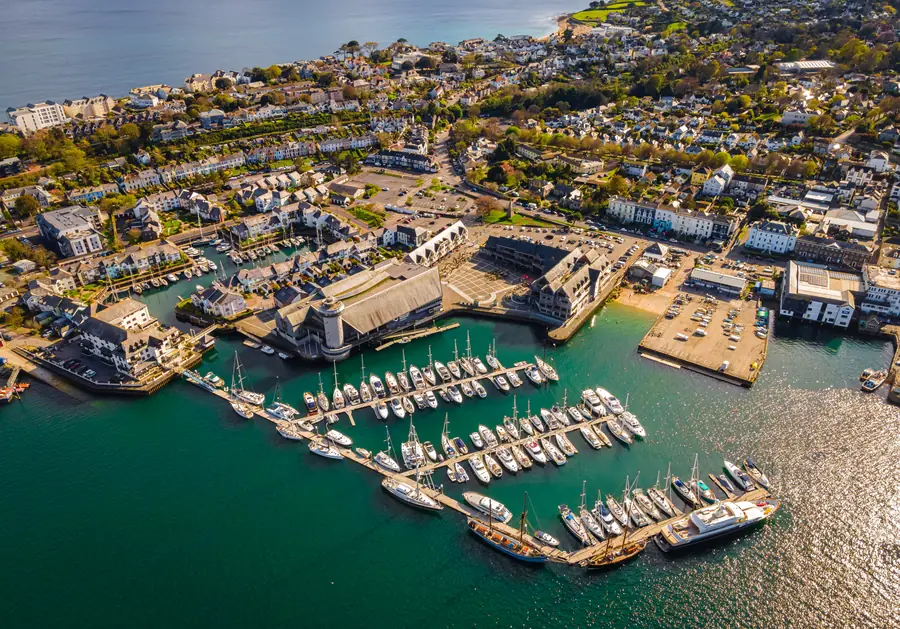
The National Maritime Museum Cornwall stands on Discovery Quay in the middle of Falmouth, in a building designed by M. J. Long after an RIBA design competition, and opened in 2003.
It is a national museum that receives no direct government support — an independent charitable trust, unlike the other institutions carrying the word “national”. Everything it does is funded by admissions, membership and donations, which is worth knowing when you look at the ticket price.
Its subject is small boats: not liners and battleships but the craft people actually built, rowed, sailed and worked from.
The design does two clever things.
The Tidal Zone takes you below the waterline to a window looking directly into the harbour, where you can watch the sea and whatever is in it against a gauge showing the tide. It is one of only a few places in the world where you can stand under the water level and look out.
The Lookout Tower at the top gives a 360-degree view over Falmouth, the docks and Carrick Roads — the best free-standing viewpoint in the town short of the castle.
Between them, the Flotilla — the main hall, with boats suspended at different heights from floor to roof, which is what most people photograph.
The National Small Boat Collection is here, alongside the museum’s own holdings — around 140 vessels in total, of which a rotating selection is displayed.
Cornwall’s maritime history: pilot gigs, luggers, the packet ships that made Falmouth’s fortune carrying mail and bullion across the Atlantic from 1688, wrecking, fishing and the port.
Temporary exhibitions are substantial and are what makes repeat visits worthwhile — recent programming has included a well-received history of surfing that visitors singled out.
Interactive galleries: sailing simulators, knot-tying, a hands-on boatbuilding area, and enough to hold a four-year-old for an afternoon.
Accessibility. Visitors describe it as among the best-designed venues they have used with a wheelchair — level access, lifts to all floors including the tower and the tidal zone, and space to move.
Weather. It is entirely indoors, which in Cornwall matters. It is the default wet-day plan for a good proportion of Falmouth’s visitors, so expect it to be busier in rain.
Admission charged. The ticket normally converts to an annual pass at no extra cost — ask, because it is not always volunteered and it changes the value calculation entirely if you are in Cornwall for a week.
Time: two to three hours. Most visitors report staying longer than they expected.
Facilities: café, shop, toilets, baby changing.
Location: Discovery Quay, in the town centre, five minutes from the main shopping street.
Parking: the Events Square car park adjoins.
Getting there: Falmouth Town station is a short walk; the branch line from Truro runs to it.
No. It is an independent charitable trust and receives no direct government funding, despite the “national” in its name.
A gallery below the waterline with a window into the harbour, where you can watch the sea against a tide gauge.
Two to three hours. Visitors regularly stay longer than planned.
Yes — the interactive galleries, simulators and hands-on boatbuilding work well from about four upwards.
Normally the admission converts to an annual pass at no extra cost. Ask when you buy.