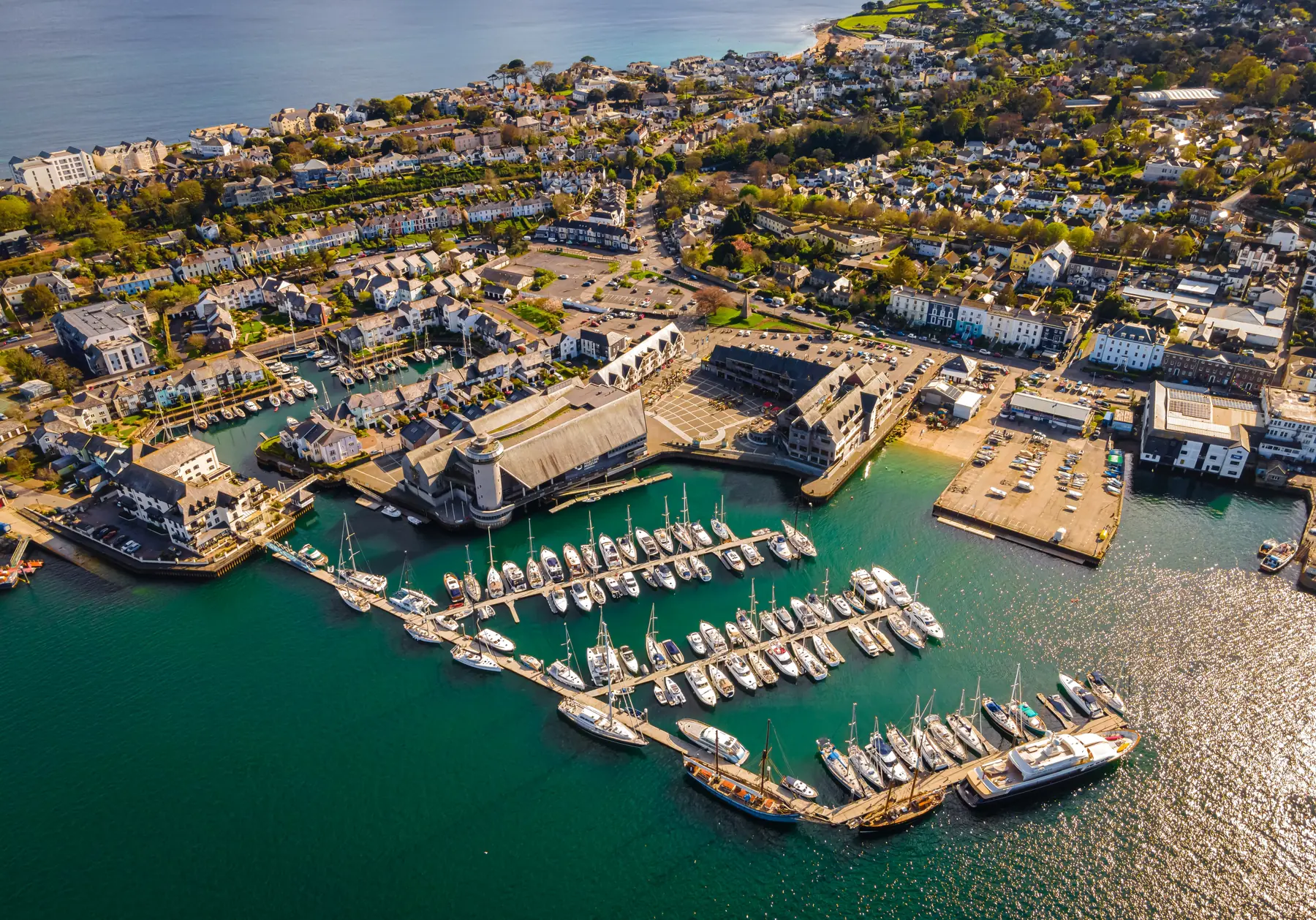
Falmouth is close to being the ideal family town in Cornwall, and the reason is that everything is within walking distance of everything else. Four beaches, a castle, a national museum, a working harbour and half a dozen boats you can get on are all inside two kilometres of the town centre, and you can arrive by train.
It is also less overwhelmed than St Ives or Padstow in August, which matters more than it sounds when you are trying to park a family somewhere.
The National Maritime Museum Cornwall sits on the harbourside in a purpose-built building at the edge of the town, and it is the wet-weather insurance for the whole area. It is built around a hall of small boats hung at every level, with a tidal zone below sea level where you can watch the water through windows, a tower with a view over the harbour, and a great deal of hands-on material about navigation, boatbuilding and the sea.
It works for a wide age range and takes two to three hours. Tickets are typically valid for repeat visits over a period, which is worth knowing on a week’s holiday. See our Maritime Museum page.
Falmouth has four, and three of them are walkable from the centre.
Gyllyngvase is the main one — sand, a café, lifeguards in season, and a gentle slope into the water. It is six hundred metres from the town and it is where most families end up.
Castle Beach, next along under Pendennis, is smaller, rockier and much the best for rock pooling at low tide. There is an established rock pool project running family sessions here.
Swanpool has sand, a café, a boating lake behind it and a nature reserve.
Maenporth, four kilometres south, is the quiet one, with a café and space.
Our beaches guide covers the tides, the parking and which suits what.
Getting on the water is the thing children remember, and Falmouth makes it easy.
The St Mawes ferry from the Prince of Wales Pier crosses the harbour in about twenty minutes — a proper boat trip for the price of a bus fare, with a castle and a village at the other end. The Flushing ferry is a five-minute hop across to a village with a beach. Enterprise Boats run up the river to Truro on the tide, which is a lovely slow trip through the creeks.
Beyond the ferries there are wildlife cruises looking for seals, dolphins and basking sharks in season, sea safaris in fast RIBs for older children, and kayak and paddleboard hire from Gyllyngvase. Our boat trips guide sets out the options.
Pendennis Castle is the one to do: an artillery fort on the headland above the town, built by Henry VIII, with a keep to climb, guns to look at, tunnels, a Second World War observation post and enormous views. English Heritage runs it and there is usually something on in the holidays. There is free parking at the castle.
St Mawes Castle, across the water, is the smaller sister fort and is reached by the ferry, which makes the trip itself half the fun.
The two subtropical gardens above the Helford both have a beach at the bottom, which is what makes them work with children who are not naturally interested in plants.
Trebah is a twenty-six-acre ravine of tree ferns and giant gunnera dropping to a private beach on the Helford River — there is a play area, and children are encouraged to run about in a way that is not always true of gardens.
Glendurgan, next door and National Trust, has a laurel maze planted in 1833 and a path down to the hamlet of Durgan on the water.
The Maritime Museum is the main answer. Beyond it: Falmouth Art Gallery is free and runs family activities; Kernow Escape on Market Street covers escape rooms for older children; the Cabinet of Folklore on the High Street is a small, strange and rather good museum; Raze the Roof at Penryn is the soft-play option; and the Flicka Foundation donkey sanctuary, also at Penryn, is outdoors but the animals do not mind rain. Our wet weather guide has more.
Falmouth eats well and informally. The harbourside and Arwenack Street have a run of restaurants used to families, the Chain Locker on Quay Street is the classic harbour pub, and the beach cafés at Gyllyngvase and Swanpool cover lunch. Cornish pasties, obviously, and there is no shortage of ice cream. Our eating guide has the list.
Getting here by train is genuinely easy and children enjoy it: change at Truro onto the branch line and take the twenty-minute run down to Falmouth, which finishes with a view over the harbour. Falmouth Town station is four hundred metres from the centre.
Parking. Free at Pendennis Head, Pendennis Castle, Swanpool and Town Quarry. The Park and Float at Penryn is the best option of all with children — leave the car and come into town on a boat.
Hills. Falmouth is steep away from the main street. With a pushchair, stay between The Moor and the Docks, which is the flat part.
Tides matter for rock pooling and for the beaches; a tide table is worth having.
A boat and castle day. Walk down to the Prince of Wales Pier and take the St Mawes ferry across the harbour — twenty minutes on the water with ships on both sides. Look round St Mawes Castle, have lunch in the village, and take the ferry back. In the afternoon, walk out to Pendennis Point and round the headland, finishing on Castle Beach if the tide is low. Two castles, two crossings of a great harbour, and almost no driving.
A beach and garden day. Morning at Gyllyngvase with the paddleboards and the café, then out to Trebah in the afternoon for the ravine garden, the play area and the private beach on the Helford. Both have somewhere to eat and both suit a wide age range.
Under five: Gyllyngvase for the sand and the gentle water, the Flushing ferry for a five-minute boat trip, the Maritime Museum’s lower galleries, Kimberley Park.
Five to eleven: the sweet spot. Rock pools at Castle Beach, Pendennis Castle, the Maritime Museum properly, kayaking at Gyllyngvase, Trebah’s beach.
Teenagers: the RIB sea safaris, paddleboarding, the coast path, the escape rooms, and Falmouth’s own town centre, which has more going on than most Cornish towns because of the art school.
Two things catch families out. The first is tides. Castle Beach is the best rock pooling in the area at low water and a small strip of sand at high water; the reefs that make the pools also make channels that fill quickly as the tide turns. A tide table changes the day, and it is worth checking before you set out rather than after you arrive.
The second is hills. Falmouth looks flat on a map and is not. The strip from The Moor along the main street to the Docks is level, and almost everything else climbs steeply — Killigrew Street and Trelawney Road are the ones people complain about. With a pushchair or a tired child, stay on the flat strip and use the town bus loop, which runs every twenty minutes and covers the beaches and the stations.
Because you will need it. The Maritime Museum is the main event and holds a family for a full morning. Falmouth Art Gallery is free, small and runs holiday activities. Kernow Escape works for children old enough for a puzzle. Raze the Roof at Penryn is soft play. The Flicka Foundation donkey sanctuary, also at Penryn, is outdoors but the donkeys are unbothered by rain and it is free to visit with a donation. And the subtropical gardens at Trebah and Glendurgan are better wet than dry, with indoor cafés and covered play areas.
The Maritime Museum for a half day, the St Mawes ferry for the boat trip, Castle Beach at low tide for rock pools.
Gyllyngvase for sand and facilities, Castle Beach for rock pools, Swanpool for a quieter afternoon.
Yes — a keep to climb, guns, tunnels and big views, with events through the school holidays.
Yes, changing at Truro onto the branch line for a twenty-minute run into the town.
Four gives you the museum, the beaches, a ferry trip and a garden without rushing.