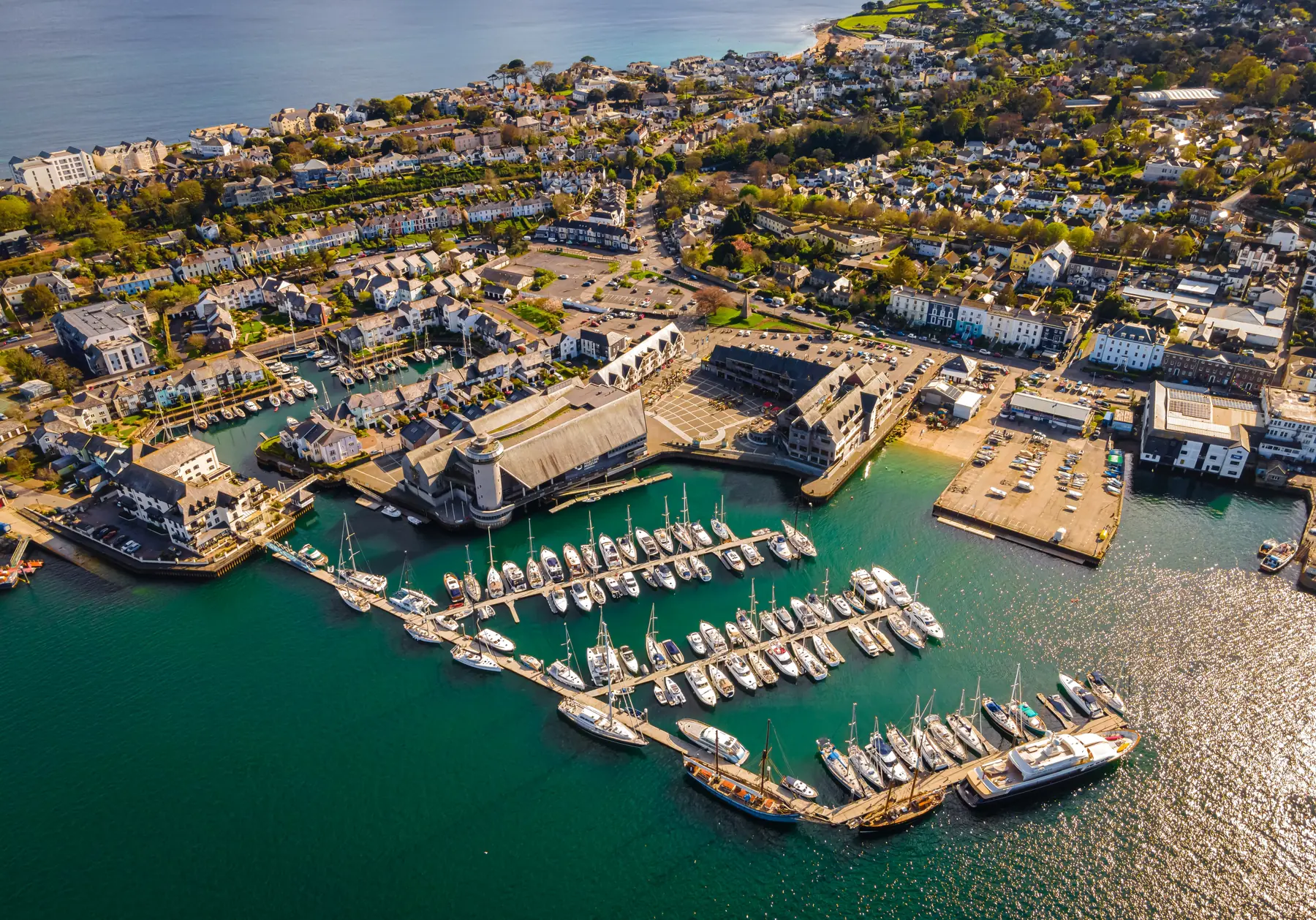
Falmouth eats far better than a town of twenty thousand people should, and the reasons are specific: a fishing port on the doorstep, an art school that has kept a young population here for decades, and a run of independent restaurants along one street that would not look out of place in a city.
The geography is simple. Arwenack Street, Market Street and Church Street run in a single line along the harbour and hold most of the good restaurants; the beach cafés at Gyllyngvase, Swanpool and Maenporth handle daytime; and the harbour pubs cover the evening.
INDIDOG on Market Street is the harbourside restaurant most people name first — modern British cooking with a view over the water. Amanzi on Arwenack Street does South African food and has one of the strongest followings in the town. Cribbs next door covers Caribbean cooking. The Chic Pea, also on Arwenack Street, does falafel and Middle Eastern food well and cheaply.
Restaurant MINE, tucked into the Old Brewery Yard off the High Street, is the ambitious one — small, seasonal and the place Falmouth books for an occasion. Wilder on Church Street is plant-based Indian cooking and is one of the best-rated restaurants in the county. Bodega 18 covers tapas.
The pattern is worth noting: for a small Cornish town this is an unusually international list, and it reflects a population that is not only holidaymakers.
You are in a fishing port on a coast famous for shellfish, and the seafood is the reason a lot of people come.
The Beach House at Swanpool does it with a sea view. The harbour restaurants all carry local fish, and the day boats landing at Falmouth supply much of it. Falmouth Bay oysters are dredged under sail in the winter months — the last commercial fishery in Europe to work that way, under a byelaw that bans engines — and they appear on menus from autumn.
Crab, lobster, mackerel, hake and monkfish are the staples. Ask what came in that day; in Falmouth the question gets a real answer.
The Chain Locker on Quay Street is the harbour pub — old, low-ceilinged, right on the water, and the first place most visitors are sent. The Star and Garter on the High Street does food seriously and has a terrace with a harbour view. The Greenbank Hotel on the harbourside has a bar with one of the best views in Cornwall.
Away from the water, the Boathouse, the Front — a cellar bar with a formidable real ale list — and a cluster of pubs around The Moor cover the rest. Falmouth has a lively pub scene by Cornish standards, helped considerably by the students.
Across the water, Flushing has two waterfront pubs reached by a five-minute ferry, and St Mawes has more. Going for a pint by boat is a very Falmouth thing to do.
Gyllyngvase has a beach café that does proper food and stays open into the evening in season. Swanpool and Maenporth both have their own. All three are the natural stop on a coast path walk, and all three are better than beach cafés usually are.
Out at the Helford, the gardens at Trebah and Glendurgan both have cafés, and there are pubs at Helford Passage and Mawnan Smith.
Falmouth has several bakeries doing proper pasties, and the difference between a good one and a bad one is considerable. Cornish cream tea comes with jam first, then cream — the Devon method is the other way round and saying so in public here is a decision.
Beyond that: Cornish cheese, Cornish gin and cider, and a serious local brewing scene. Cornish sea salt, saffron cake and hevva cake all turn up in the bakeries.
There is a good weekly market on The Moor, several delis and a fishmonger, and the supermarkets are on the edge of town. For self-catering, the Penryn and Constantine village stores are both better than they need to be — Constantine Stores in particular has a wine and spirits selection with a national reputation.
Booking. July and August are busy, and Falmouth Week in August — the largest sailing regatta in the south-west — fills the town completely. Book ahead for both.
Term time. The university changes the town’s rhythm. In term the cheaper places are busy and lively; in summer the visitors take over.
Out of season. A number of places reduce hours or close from November to March, particularly the beach cafés and the boat-dependent options across the water.
Hills. The restaurants are all on the flat strip between The Moor and the Docks. Everything else in Falmouth is uphill.
Breakfast in one of the independents on Market Street or Arwenack Street. Mid-morning coffee looking at the harbour from Custom House Quay. Lunch at the Gyllyngvase beach café with your feet more or less in the sand. Afternoon cream tea — jam first — somewhere in the town. Dinner at MINE, INDIDOG or Amanzi, booked in advance. And a last drink at the Chain Locker or, better, on the ferry across to Flushing for a pint at the water’s edge and back.
The whole thing except the last stage is inside fifteen minutes’ walk, and the last stage is the best part.
Three short trips worth making. Flushing, five minutes across the water, has two waterfront pubs. St Mawes, twenty minutes by ferry, has several places including the Hotel Tresanton’s dining room, which is the smartest eating in the area. And the Helford, six to ten kilometres south-west, has pubs at Helford Passage and Mawnan Smith and cafés at Trebah and Glendurgan.
CJ’s at the Sanctuary at Budock Water and Hotel Meudon at Maenporth are both short drives and both have strong local reputations. Constantine, eight kilometres west, has a village store with a wine and spirits selection of national repute, which is not a sentence you often write about a Cornish village.
It is worth understanding why the food here is what it is, because it explains the difference between Falmouth and comparable Cornish towns.
Falmouth has an art school with a long history and, since the 2000s, a university campus shared with Exeter at Penryn a few kilometres up the river. That means several thousand young people live here year-round, and they need to eat cheaply and want to eat interestingly. The result is a layer of falafel, plant-based, tapas, Caribbean and South African cooking that a town of twenty thousand holidaymakers would never sustain on its own, sitting alongside the seafood restaurants and the harbour pubs.
The practical consequence for a visitor is that Falmouth is one of the few places in Cornwall where you can eat very well for very little, and where the vegetarian and vegan options are genuinely good rather than an afterthought. It also means the town has a proper year-round evening economy — a real advantage in October, when much of the Cornish coast shuts.
Three dates fill the town. Falmouth Week in August is the largest regatta in the south-west and the restaurants are full for its duration. The Sea Shanty Festival in June packs the pubs and the quays. And the Oyster Festival in October marks the opening of the dredging season and is the best food weekend of the year here.
Outside those, July and August are busy but bookable a day or two ahead, and May, June, September and early October are the sweet spot — everything open, nothing full, and the sea at its warmest in September.
From November to March a proportion of the seasonal places close, but the harbour-street restaurants, the pubs and the university-driven cheaper end all run year-round.
Restaurant MINE for an occasion, INDIDOG for the harbour view, Amanzi and Wilder for something different.
The Beach House at Swanpool, the Greenbank bar, the Gyllyngvase beach café, and the harbour restaurants on Market Street.
The Chain Locker and the Star and Garter on the harbour, the Front for real ale, and the Flushing pubs across the water.
Unusually so for Cornwall — Wilder and the Chic Pea are both largely or entirely plant-based and both are well regarded.
August. It is the biggest sailing regatta in the south-west and the town is completely full.