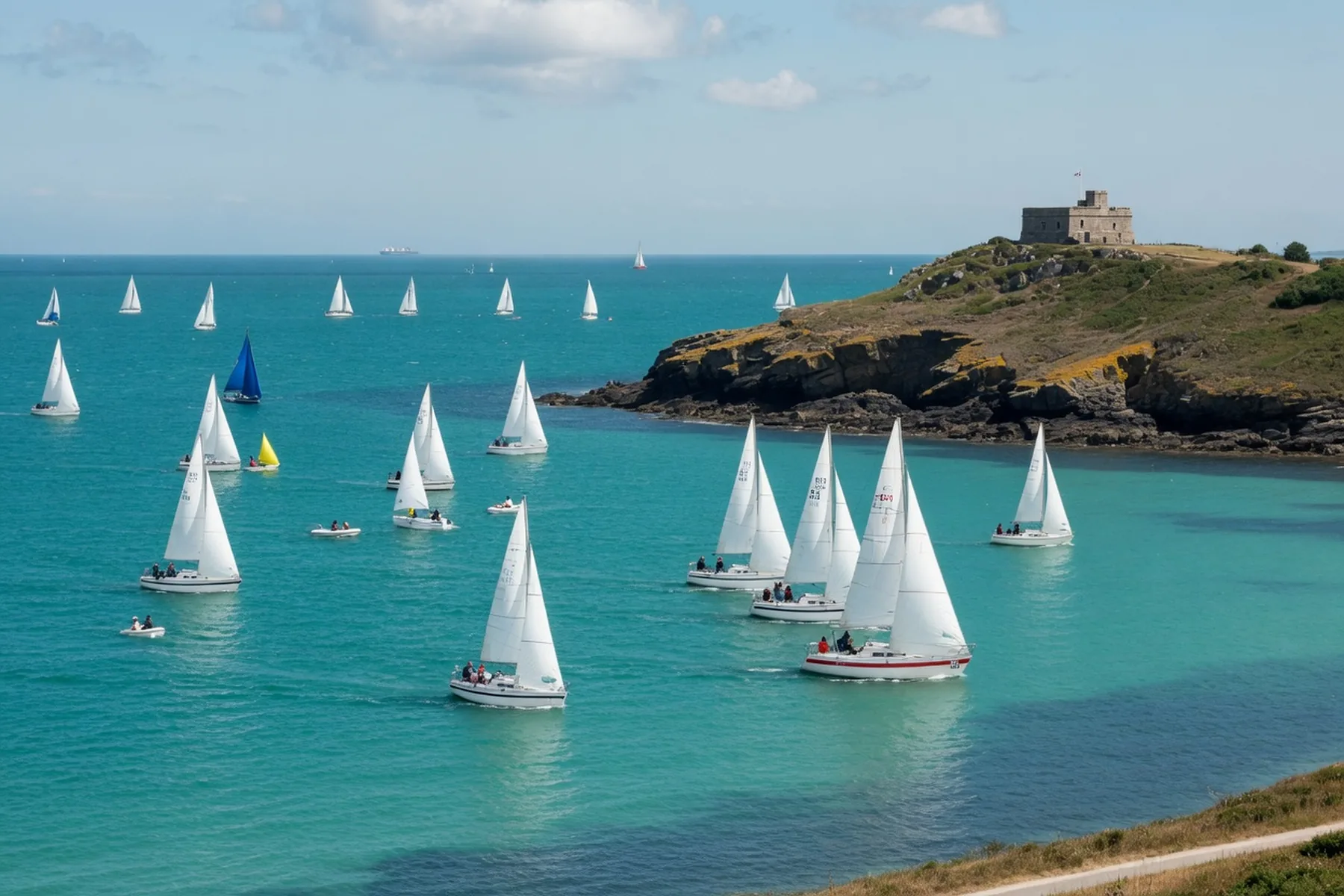
Falmouth is one of the few Cornish towns that does not close when the visitors leave. A university campus up the river at Penryn, a working dockyard and a year-round ferry to St Mawes keep the lights on in January. That does not mean every month is the same month. The sea, the gardens, the boats and the beds all move on different calendars, and picking the wrong weekend can mean Falmouth Week with no room, or a garden visit on a Monday when Glendurgan is shut.
April and May. Everything useful is open, the gardens are at their best — magnolias, camellias, rhododendrons at Trebah and Glendurgan — and the town is not yet full. The sea is still cold. This is the month for walking, gardens and the harbour, not for a long swim.
June. The first festival weekend of the summer, then a stretch of proper opening hours without August prices. Sea temperatures are climbing. If you want boats, beaches and a table without booking a week ahead, late June is the bargain.
July. Busy, bookable, and the month visitors from inland think of as peak. The sea is not yet at its warmest. School holidays fill the beaches from mid-month.
August. The busiest month, and in the second week it is something else entirely: Falmouth Week. If you want the regatta, come then and book everything. If you want a quiet town, do not.
September. The sea is at its warmest — late August into September is when Cornish people swim — the gardens still look like themselves, and the families have gone. This is the month we would pick for a first visit.
October. The Oyster Festival, the start of the sailing dredge, shorter days, and a town that has not yet gone winter. A good food weekend and a good walking month. Some seasonal ferries and beach cafés wind down.
November to March. Wet, mild by British standards, and more open than the north Cornish coast. The St Mawes ferry runs. The Maritime Museum and the art gallery carry wet days. Trebah stays open; Glendurgan does not. Accommodation is cheaper. The university is in term, so the cheaper restaurants stay lively. It is not a beach holiday.
Europe’s largest free sea-shanty festival, founded in 2003, now drawing on the order of 65,000 to 70,000 people over three days. In 2026 a record 91 groups were booked, with hundreds of performances in pubs, on quays and at the Princess Pavilion. The Gala Concert is the one ticketed event; the rest is free. Money raised goes to the Falmouth RNLI.
Practical consequences: Falmouth Town station has been closed for the weekend, with trains terminating at the Docks; a campus park-and-ride runs from Penryn; the pubs are full; the quays are a stage. Stay outside town or book early. If shanties are not why you came, this is a weekend to skip or to spend on the Helford.
The largest sailing regatta in the south-west, with more than 400 yachts over the week and a shore programme that has grown around it. Origins as a local regatta go back to 1837. Racing in the bay and the Carrick Roads is the point; the rest is carnival, live music, a family day and fireworks.
In 2026 the week runs Friday 7 to Sunday 16 August. The days that concentrate people hardest are the carnival Saturday, the Red Arrows display on Wednesday 12 August, and fireworks over the harbour on Friday 14 August. Restaurants are full for the duration. See parking in Falmouth before you drive in, and boat trips if you want to be on the water rather than watching it.
Come for it, or come the weeks on either side. Do not come by accident.
Four days on Events Square celebrating the opening of the Fal oyster season. Falmouth Bay oysters are dredged under sail from October to March, the last commercial fishery in Europe still working that way. Chefs, music, a lot of shellfish, and a town that is busy without being August. Book a table if you want a restaurant rather than a stall.
A beer festival usually follows later in September or around the same stretch of autumn — in 2026, 25 and 26 September — which is worth knowing if you wanted a quiet Friday.
Falmouth has had an art school for a long time and, since the 2000s, a university campus shared with Exeter at Penryn. Several thousand students live here through the academic year. Term runs roughly October to December and January to June, with a long summer vac.
What that means for a visitor: the cheaper, more interesting restaurants stay open all year; the town has an evening economy in November; and late September, when students return, is livelier than the equivalent week in Padstow or St Ives. It also means that “out of season” here is not the shuttered out-of-season of a pure resort. See where to eat.
Swimming. Sea temperatures around Falmouth peak in late August and September and bottom out in February and March. Gyllyngvase is the swimming beach; there is a year-round cold-water crowd. Lifeguards are a summer provision. See Falmouth’s beaches.
Gardens. Trebah is open all year. Glendurgan runs from mid-February into November and is closed most Mondays outside August. Spring is the colour; summer is the gunnera; winter at Trebah is structure and quiet. See Trebah and Glendurgan.
Ferries. St Mawes runs year-round with a thinner winter timetable. Flushing and the Helford crossing are more seasonal. Wildlife trips and RIBs are Easter to October. A February visit can still put you on the harbour; it will not put you on a sea safari.
Pendennis Castle. Daily in the main season; shorter hours and some closed weekdays in winter. Combine with the museum on a wet day.
July and August — accommodation first, then restaurants, then anything on the water. Falmouth Week is a separate, harder version of the same rule.
Festival weekends — do not arrive without a bed. The radius of “full” includes Penryn, Mawnan and St Mawes.
May, June, September — book the better restaurants a day or two ahead and you will be fine.
Winter — book less, check opening hours more. Beach cafés, some ferries and Glendurgan will be shut; the museum, the castle on its winter days, the harbour pubs and Trebah will not.
Come in September if you can: warmest sea, open gardens, no Falmouth Week, tables that exist. Come in May for the gardens and empty coast path. Come in June if the shanties are the point, and stay the following week if they are not. Come in August only on purpose.
Come in winter if you like harbours more than beaches. The town can take it.
September, then May and June. August if you want Falmouth Week; not otherwise.
7 to 16 August in 2026, with the Red Arrows on the 12th and fireworks on the 14th. Dates shift a little each year.
The second weekend of June — 12 to 14 June in 2026. Free, very full.
Yes. The harbour, the museum, Trebah, the St Mawes ferry and a lot of the restaurants run year-round. The beaches and some boats do not.
Late August and September, which is why the swimming season here is not July.