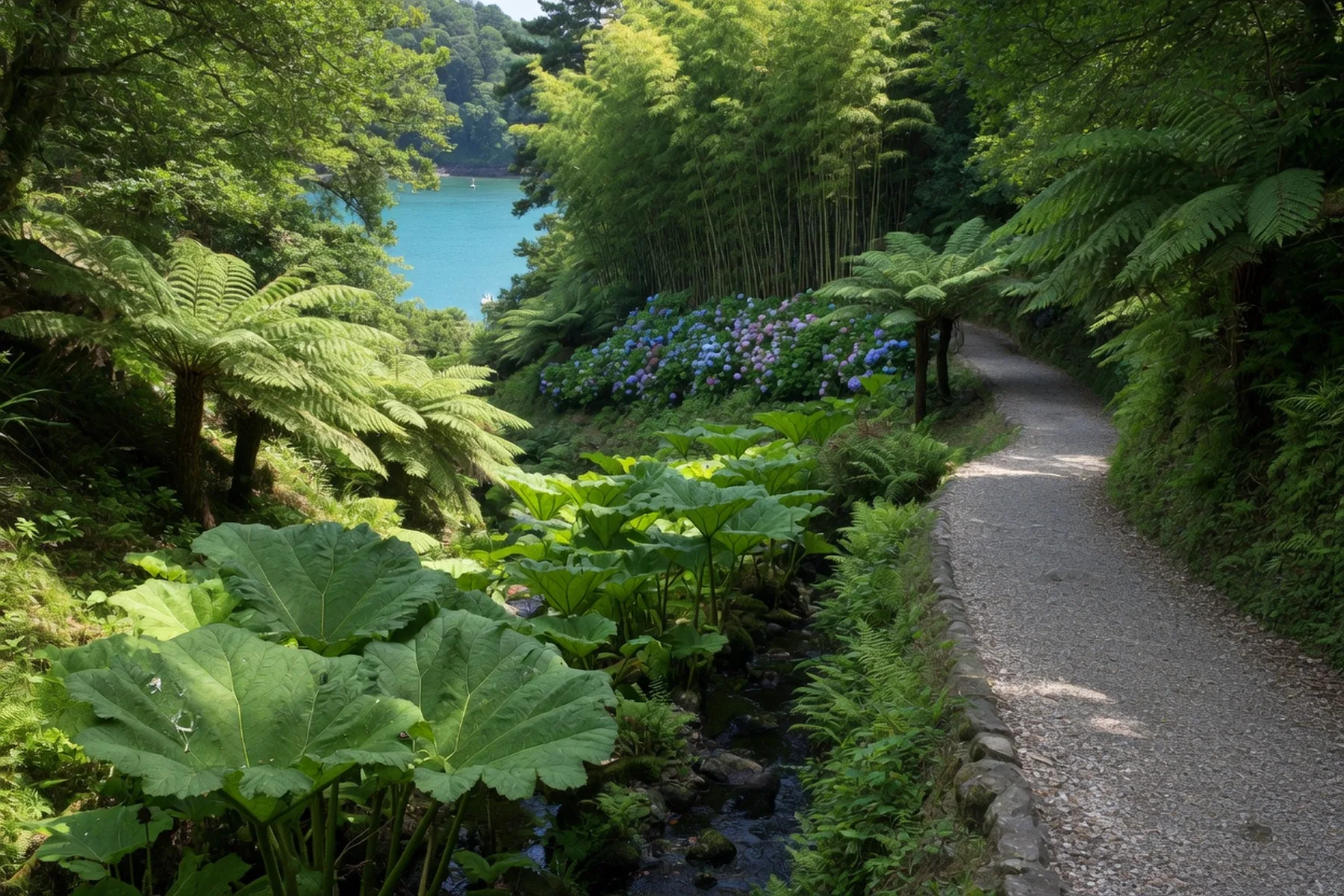
Six kilometres south of Falmouth, two gardens drop through sheltered valleys to private beaches on the Helford River. They were made by brothers. They sit next door to each other. They are the best day out from the town that does not involve a boat, and they are easy to muddle, which is a mistake, because they are not the same place.
Trebah is the wilder ravine: tree ferns, a river of giant gunnera, a shingle cove that loaded American troops for Omaha Beach. Glendurgan, National Trust, is the more classical pleasure ground: a laurel maze planted in 1833, a giant’s stride, a path down to the hamlet of Durgan. Do both if you can. If you can only do one, the choice is below.
Twenty-six acres in a south-facing valley, planted from the 1830s by Charles Fox of the Falmouth Quaker shipping family. The Gulf Stream and the shape of the ground do the rest: what grows here would not live through a normal English winter.
You walk down. That sounds obvious and it is the thing that catches people. The path falls through tree ferns into the gunnera — leaves the size of tables, a tunnel rather than a border — then hydrangeas in late summer, a water garden, and Polgwidden Cove at the bottom. The cove is included with the ticket, has a beach café in season, and you can swim.
In June 1944, 7,500 men of the American 29th Infantry Division embarked here for Omaha Beach. There is a memorial at the cove and a proper exhibition in the visitor centre. Do the exhibition before you walk down, not after: the beach reads differently once you know what left from it.
The walk back up is a steady climb. There are benches and a longer, gentler line; there is also a shuttle on some days. Ask at the desk if knees or a buggy are a consideration.
Trebah is open daily from 9.30am, all year, as an independent charitable trust. Adult admission in 2026/27 is £17.50 (more with Gift Aid); children 5–15 half that; under-fives free. Summer 2026 had a temporary VAT cut passed on at the gate. Dogs are welcome, which is not the default in Cornish gardens.
Facilities: Trebah Kitchen at the top, the Boathouse café on the beach from spring to autumn, a good shop and plant centre. The upper garden has accessible routes; the valley is steep gravel. Two Tramper scooters can be booked through Countryside Mobility.
See our Trebah page for the shorter version.
Alfred Fox, Charles’s brother, laid this one out in the 1820s and 1830s. The Foxes gave it to the National Trust in 1962. The Cornish name, Glynn Dowrgeun, means a deep valley of otters, which is still not impossible.
Three valleys run down to the river. The maze is the thing children aim at: cherry laurel, 1833, one of the oldest surviving hedge mazes in Britain, set on a slope so you can watch other people fail from the path above. The Giant’s Stride — a maypole with ropes — sits on the lawn below it. Both are original Victorian play, still used.
The planting is the spring garden of the pair: magnolias, camellias, rhododendrons, a tulip tree, bluebells in April. Summer is quieter and greener. The path ends at Durgan, a handful of cottages on a shingle beach with no real road in. You can swim. You walk back up the same hill Trebah just made you walk.
Glendurgan is typically open Tuesday to Sunday from mid-February into November, daily in August, plus bank-holiday Mondays. Closed Mondays the rest of the season, and closed in winter. Adult tickets in 2026 have been in the mid-teens; National Trust members are free, which decides the question for a lot of households. The car park is extra — about £5 for the day, JustPark, locked at closing.
Dogs are allowed in much of the garden but not in the maze, the orchard or the schoolroom. Access is the same problem as Trebah: a valley. There is a step-free purple route; the red route has steps.
See our Glendurgan page.
With children: Glendurgan, for the maze and the Giant’s Stride.
For drama and a swim with a café: Trebah.
If you have National Trust membership and one ticket to buy: Glendurgan is free; spend the money at Trebah the same day or another.
In February and March: both, for the magnolias and camellias, but Trebah is the one that is actually open if you have come in winter.
In late summer: Trebah, for the gunnera at full height and the hydrangeas.
A wet day: either. Tree ferns and moss want the rain, and both gardens look like the places they are pretending to be. Trebah has more indoor exhibition if you need to dry off. See Falmouth in the rain.
Doing both in a day is the right plan if you have the legs. They are a few minutes apart by road or a short walk, and you will not see the same garden twice. Start at the one that opens earlier (Trebah, 9.30), walk down and up, then Glendurgan from 10.30. Eat at one of the two cafés; do not try to add St Mawes on the same day.
Mawnan Smith, about fifteen minutes from Falmouth by car, brown signs off the A39. The lanes into the village are Cornish lanes: narrow, slow, and a poor place to meet a coach. Parking is at each garden, not in the village.
Buses run from Falmouth in season (the 35 toward Helston is the usual). There is no ferry from Falmouth to the gardens. The seasonal Helford passenger ferry, below Trebah at Helford Passage, is how you turn a garden visit into a walk to Frenchman’s Creek on the south bank — see our walks guide and day trips.
Time. Two to three hours each, more with lunch and a swim. Both is a full day.
The climb. Down is a pleasure. Up is the bill. If that is going to spoil it, Trebah’s shuttle and Glendurgan’s purple route are the mitigations; neither garden is flat.
Seasonal cafés. Trebah Kitchen runs year-round; the beach café does not. Glendurgan’s tea-house follows garden opening days.
Tickets. Buy Trebah on the day or online; Glendurgan is ordinary National Trust. There is no joint ticket.
What not to do. Arrive at 2pm in August and hope to do both, including the beaches, and be back for a 5pm ferry. The valleys take the time they take.
Yes, and you should if you have the time. They are next to each other and they are not the same.
Trebah for the ravine, the gunnera and the D-Day beach. Glendurgan for the maze, spring colour and National Trust membership.
At Trebah, yes. At Glendurgan, in much of the garden but not the maze, orchard or schoolroom.
It is much easier with one. Buses exist in season; the Falmouth–Helford ferry does not land at the gardens.
Yes, at Polgwidden Cove (Trebah, ticketed) and at Durgan (at the bottom of Glendurgan; the beach itself is public). The Helford is a river, not the open sea — sheltered and cold.