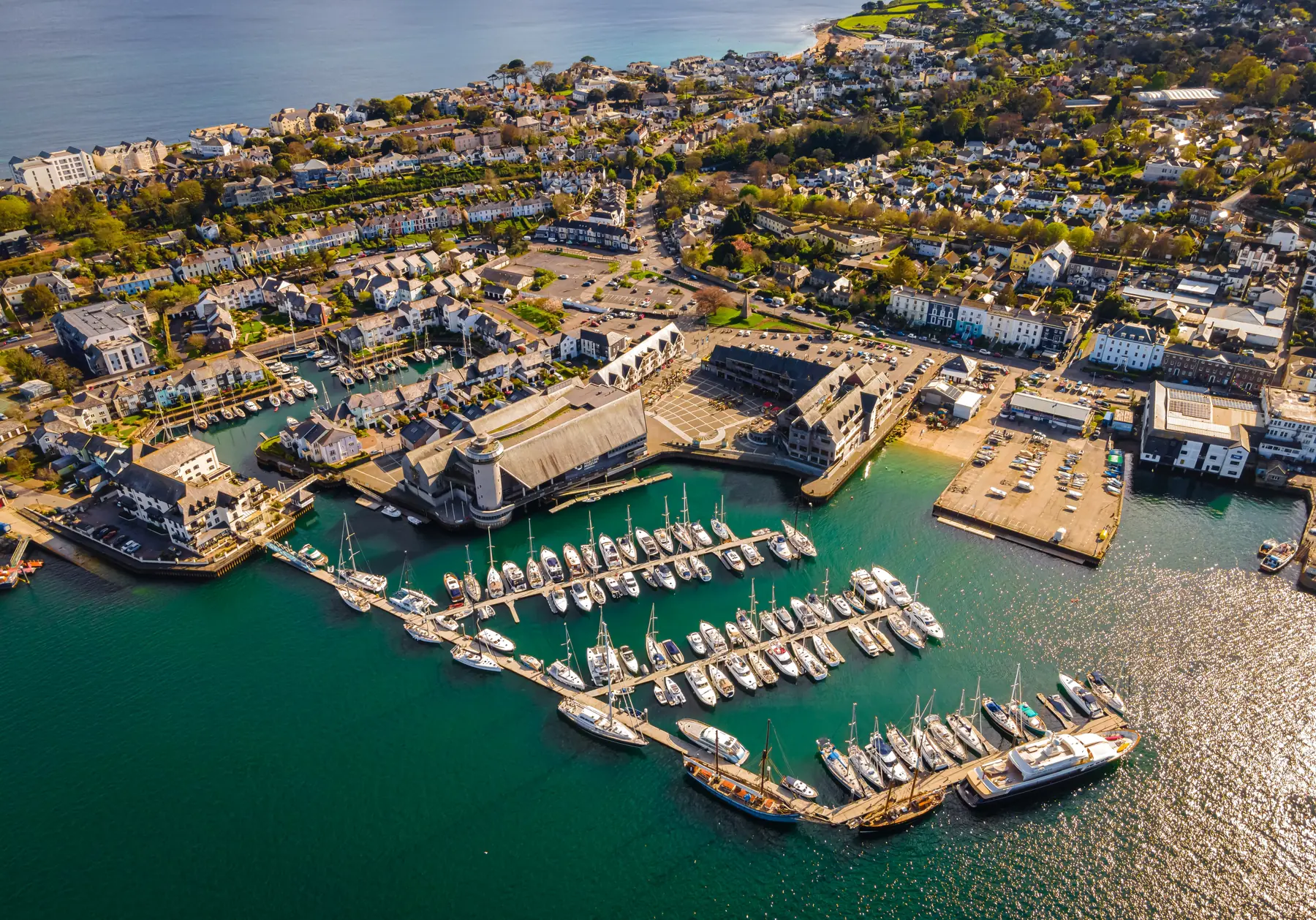
Falmouth is a good base for west Cornwall because it sits in the middle of it. The Lizard is half an hour south, Truro twenty minutes north, St Ives and Penzance under an hour west, and the Eden Project and the Roseland are both easy. It also has three railway stations and a harbour full of boats, which means several of the best trips do not need a car at all.
Two warnings about Cornish driving. The A39 and A394 are the arteries and both queue badly in August. And the lanes beyond them are narrow, high-hedged and slow — a ten-kilometre journey can take half an hour.
Three and a half kilometres away as the gull flies and a twenty-minute ferry from the Prince of Wales Pier. St Mawes is a village of steep lanes above a sheltered harbour, with St Mawes Castle — Pendennis’s sister fort, built by Henry VIII between 1540 and 1542 — above it. A second, smaller ferry runs on to Place, where the coast path leads out to St Anthony Head and its lighthouse.
The Roseland Peninsula beyond is one of the quietest and prettiest corners of Cornwall: St Just in Roseland, whose churchyard drops through subtropical planting to a tidal creek, is one of the most-photographed places in the county. Portscatho and Porthcurnick are on the open coast.
A five-minute ferry to a village of eighteenth-century captains’ houses, with a shore path to Mylor and its yacht harbour. A short, cheap and thoroughly enjoyable half day.
Six to ten kilometres south-west, and the loveliest estuary in Cornwall — wooded to the water’s edge, with creeks running inland. Trebah and Glendurgan are subtropical valley gardens above it, each with a private beach; the Helford ferry crosses in season to the south bank and Frenchman’s Creek, the inlet Daphne du Maurier wrote about. Helford village and Gweek, with its seal sanctuary at the head of the river, complete it.
Twenty minutes by train from any of Falmouth’s three stations, or half-hourly by the U1 bus. Cornwall’s only city and its capital: a Victorian Gothic cathedral, the Royal Cornwall Museum, Georgian streets and the county’s best shopping. Enterprise Boats also run up the river from Falmouth on the tide, which is a much better way to arrive.
Fourteen kilometres north. The heart of the Cornish mining landscape, now a World Heritage Site: East Pool Mine with its working beam engines, Wheal Peevor, the Basset Monument on Carn Brea, and Cornwall Gold. Bleaker than the coast and considerably more interesting than most visitors expect.
Helston, sixteen kilometres, has the Museum of Cornish Life and the Flambards theme park, and is the gateway to the peninsula.
Beyond it the Lizard is the most southerly point in mainland Britain, with Kynance Cove — serpentine rock, white sand and turquoise water, and one of the most beautiful beaches in the country — Lizard Point, Cadgwith and Coverack. Poldhu, where Marconi sent the first transatlantic radio signal, is on the west coast of the peninsula.
Allow a full day. The lanes are slow and Kynance’s car park fills early.
St Michael’s Mount at Marazion, around forty-five minutes, is a tidal island with a castle and a causeway you can walk at low water. Penzance has the Jubilee Pool, an art deco lido on the seafront.
St Ives, an hour, has Tate St Ives, the Barbara Hepworth Museum, Porthmeor beach and the best light in England — which is why the artists came. It is extremely busy in summer; go early or out of season.
Land’s End, Porthcurno and the Minack Theatre — a Greek-style amphitheatre cut into the cliff — are a longer day, around an hour and a quarter each way.
The Eden Project near St Austell, around forty-five minutes, is the definitive Cornish attraction and the definitive Cornish wet-day plan: enormous biomes housing rainforest and Mediterranean planting in a former china clay pit.
The Lost Gardens of Heligan are nearby and are the outdoor counterpart — a Victorian estate garden rediscovered and restored after decades of neglect.
Mevagissey and Charlestown, with its tall ships, are on the same run.
Falmouth is unusually good at this. Three stations serve the branch line to Truro, twenty to twenty-five minutes away, where you change for the main line — there is no direct train from London, so plan on the change. From Truro, trains run west to Penzance and St Ives and east towards Plymouth.
Buses run half-hourly to Truro on the U1 and Redruth on the U2, take contactless payment, and weekly area passes are available. Town services loop the beaches and the stations.
And then there are the ferries: St Mawes, Flushing, the Helford in season, and Enterprise Boats up the river to Truro. Between them they cover several of the best days out here without a car.
The getting here page sets out how to reach Falmouth in the first place.
The Roseland day, no car. Ferry to St Mawes in the morning, look round the castle and the village, take the second ferry to Place and walk the coast path to St Anthony Head for the lighthouse and the view back across the harbour. Return by both ferries. Around eight kilometres of walking and two boat trips, and the best day out from Falmouth.
The Helford day. Bus or drive to Trebah or Glendurgan, spend the morning in the garden and on its private beach, take the seasonal ferry across the river in the afternoon and walk to Frenchman’s Creek, then back for a pub lunch at Helford Passage. Subtropical planting, a wooded estuary and a boat, in one day.
The Lizard day. South through Helston to Kynance Cove for the morning — go early, the car park fills — then Lizard Point for the most southerly café in Britain, and Cadgwith or Coverack in the afternoon. A full day of driving on slow roads and worth every minute.
Cornwall in August is a traffic problem as much as a holiday destination. The A39 and A394 queue, the coastal lanes are single-track with passing places, and the honeypot car parks — Kynance, St Ives, Eden — fill by mid-morning.
Three habits fix most of it: start early, go midweek where you can, and use the trains and ferries for the trips that support them. The Roseland and Helford days above involve almost no driving at all, which in a Cornish August is worth more than the fare.
The Cornish rule is that the north and south coasts get different weather on the same day, and Falmouth sits on the sheltered southern side. When the wind is in the south-west and the north coast is unusable, the Carrick Roads and the Helford are flat. When it is in the east — rarer, but it happens — the reverse applies and St Ives is the place to be.
That gives you a simple way to plan. Sheltered days: the ferries, the Roseland, the Helford, the river to Truro. Clear settled days: the Lizard, Kynance, Land’s End and the Minack, which are all about big views and are wasted in cloud. Wet days: Eden, Truro, the mining museums at Redruth and Pool, all of which are largely indoors.
The one trip that works in any weather is the Roseland by ferry, because the boat runs in all but rough conditions and the walking is sheltered.
St Mawes and the Roseland by ferry for a half day, the Lizard for a full one, St Ives if you want a change of scene.
Around forty-five minutes by road, near St Austell.
Yes, changing at Truro and again at St Erth for the branch line. Allow around an hour and a half.
Yes, but go early — the car park fills, and the lanes down are slow.
The St Mawes ferry runs year-round in normal weather with a reduced winter service; the Helford ferry and several boat trips are seasonal.