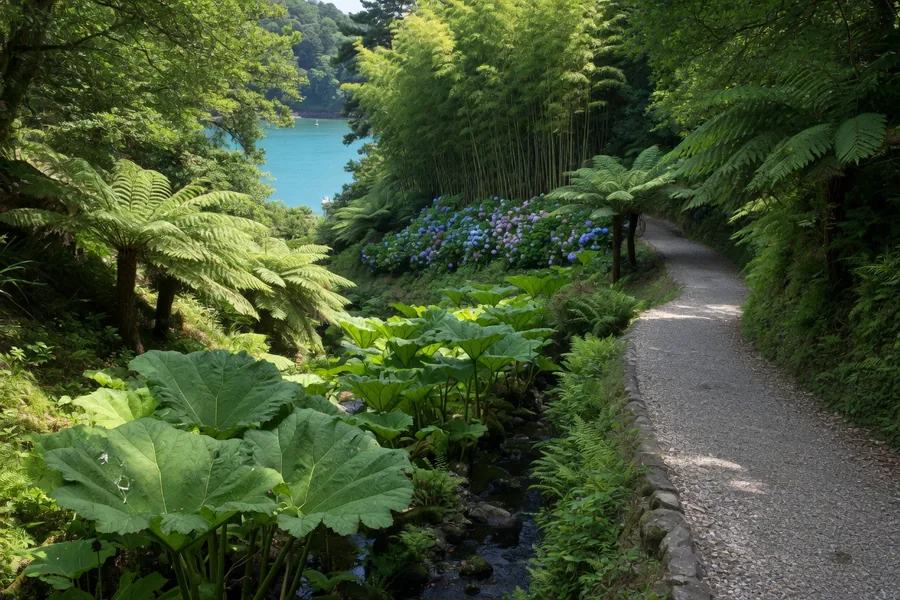
Trebah — Lowarth Treverybow — is a 26-acre garden in a steep-sided valley running down to the Helford River, about six kilometres south of Falmouth in the parish of Mawnan.
It is one of the great Cornish sub-tropical gardens, and its particular quality is the shape of the ground: a ravine, planted from the top down, so you walk into it and the canopy closes over you.
The valley faces south and is sheltered on three sides, and the Gulf Stream does the rest. What grows here would not survive an average English winter.
Tree ferns — a substantial collection, some very old, filling the shaded middle of the valley.
Gunnera — the giant rhubarb, planted in a mass through the valley floor that you walk under rather than past. It is the single most photographed thing at Trebah and it is genuinely startling at full height in summer.
Rhododendrons and magnolias, some of them enormous, at their best from February to May.
Hydrangeas in a great blue and white drift down the lower valley, at their best in late summer.
Bamboo, palms, echiums, agaves and a water garden with koi.
The garden was laid out in the 1830s and 1840s by Charles Fox, of the Quaker Fox family who ran Falmouth’s shipping agency and who also made Glendurgan next door and Penjerrick. It went through a long decline in the twentieth century and was restored from the 1980s by Tony and Eira Hibbert, who gave it to a charitable trust.
The valley ends at Polgwidden Cove, a private shingle beach on the Helford. It is included with entry, has a beach café in season, and swimming and paddleboarding are possible.
In 1944 it was an embarkation point: 7,500 men of the American 29th Infantry Division loaded here for Omaha Beach. There is a memorial at the cove, and the story is told in the visitor centre.
Down is easy; up is a climb. The path back from the beach to the entrance rises steadily through the valley, and it catches people out. There are benches, and a longer, gentler route.
Time: two to three hours, more with lunch and time at the beach.
The visitor centre has a well-regarded history display about the estate and its owners, which is worth doing before you walk down rather than after.
Facilities: café at the top and a beach café below; a good shop; toilets; plant sales.
Access: the upper garden has accessible routes; the valley paths are steep and gravelled and are not suitable for wheelchairs throughout. There is a shuttle on some days — ask on arrival.
Dogs are welcome, which is not true of every Cornish garden.
Open all year. Winter is quieter and the structure of the valley shows better.
Mawnan Smith, about fifteen minutes from Falmouth by road, with parking. Buses run from Falmouth in season. Glendurgan, the National Trust garden, is a few minutes’ walk away and the two are easily combined.
Twenty-six acres, in a steep valley running down to the Helford River.
Yes — Polgwidden Cove at the foot of the valley, included with entry, with a seasonal café.
February to May for magnolias and rhododendrons, high summer for the gunnera and hydrangeas. It is open and worthwhile all year.
The way down is easy; the climb back up from the beach is a steady ascent and catches people out.
Yes, they are a few minutes apart and were made by the same family.