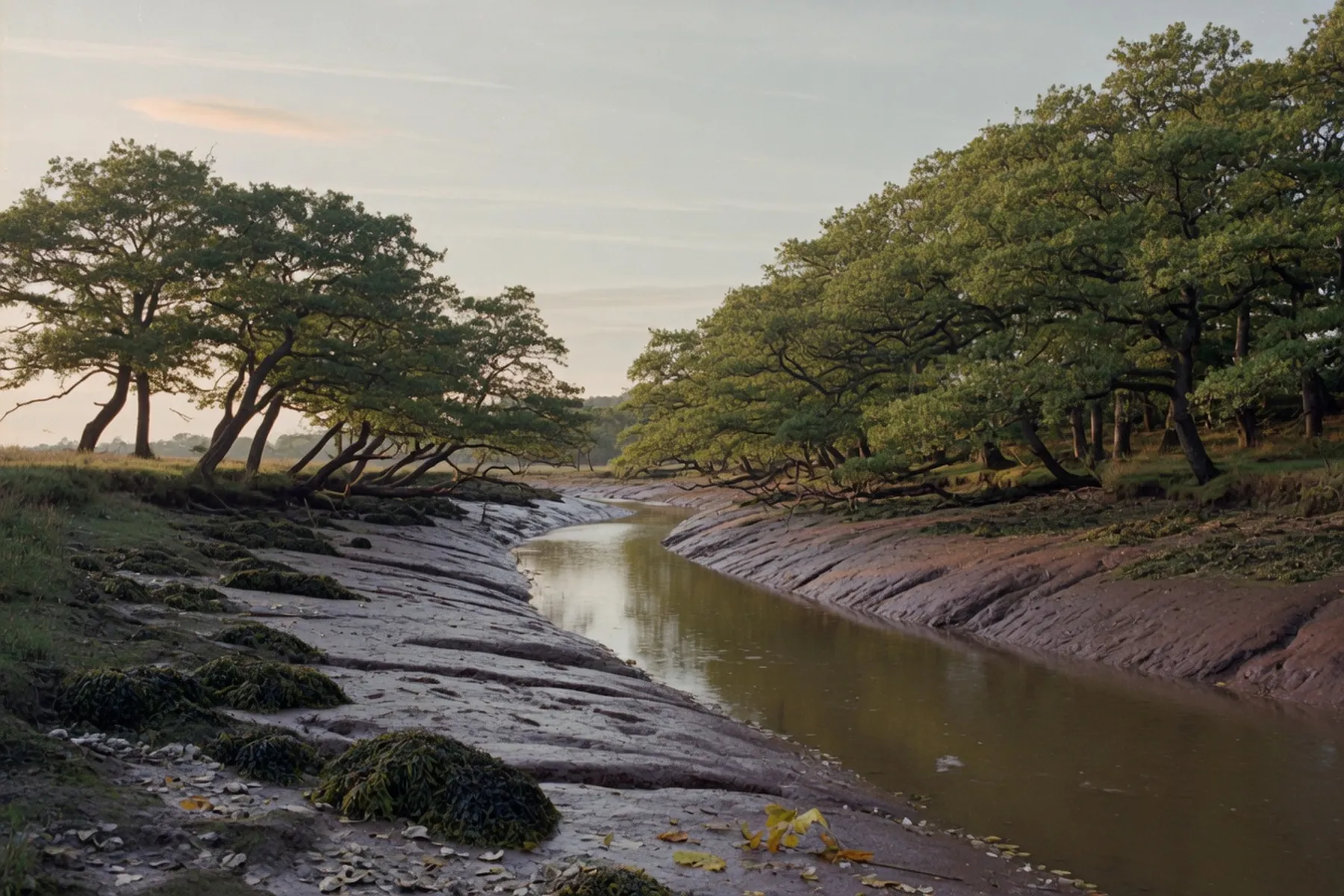
There is no boat from the Prince of Wales Pier that lands you on the Helford. What you get, a bus ride south of town, is a drowned river valley running east–west into the Lizard: oak to the water, creeks that empty to mud twice a day, and a passenger ferry that only exists for half the year.
Helford Marine Conservation’s geology leaflet puts the river at 9.2 kilometres long with 44.3 kilometres of shoreline — five times the length, because of the creeks. It is a ria, salt to the heads of those creeks, sheltered from the usual south-westerly swell and open to an easterly. That is why a day here is decided by the tide table, not the clock.
Buses 35 and 63, run by OTS on the Transport for Cornwall network, leave Falmouth Moor for Mawnan Smith, Glendurgan, Trebah and Helford Passage Turn. Together they are about hourly Monday to Saturday. The National Trust’s Glendurgan page is blunt: no buses on Sundays or bank holidays. Some journeys treat Helford Passage Turn as set-down only, so check the live 35/63 timetable on Transport for Cornwall before you rely on a pickup.
A sample weekday from The Moor: 09:45, Red Lion in Mawnan Smith at 10:00, Glendurgan at 10:02, Trebah at 10:03, Helford Passage Turn at 10:05. Those minutes move. Read the day’s board.
By car it is brown signs off the A39 toward Mawnan Smith. The National Trust warns that sat-nav from Helston will send you through Gweek, Constantine and Port Navas. Parking for the south bank is the Cornwall Council long-stay at Helford, TR12 6JU, 250 spaces, unbound surface, open 24 hours. From 1 April to 31 October a 24-hour ticket is £4.20, charged 9am to 4pm; evenings and 1 November to 31 March are free. Those are the council’s figures as of 11 August 2026. Pay at the machine — cash is still taken here — or JustPark location 8391; the signal can be weak.
Helford River Boats run the crossing from a movable pontoon on the beach at Helford Passage, in front of the Ferryboat Inn, to the jetty at Helford Point. It is on demand, not a clock-face service, and it allows for tidal flow. The operator’s published hours are 09:30 to 17:00 every day from 1 April to 31 October, stretching to 18:00 between 7 July and 7 September. After 31 October they publish no winter timetable. Treat the service as stopped unless the kiosk says otherwise.
From the village, open the yellow circular sign so the boat can see you. Pay on board, cash or card. Babies, pushchairs and dogs go free. The seasonal kiosk number is 01326 250770. Confirm the day’s hours before you walk a loop that needs the boat back — spring tides interrupt the pontoon.
The operator puts the water at less than a mile and the road at least 14 miles, about forty minutes. That is the point of the boat: it is the South West Coast Path’s way across the river.
Most of the creeks dry to mud at low water. Helford Marine Conservation measures 186 hectares of intertidal ground in a tidal area of 568 hectares. Arrive at low water and Frenchman’s Creek is a mudflat with a trickle; arrive near high water and it is a green channel under oaks. The same tide that fills the creek takes the ferry pontoon off its beach or puts it back. Check a tide table for Helford Passage, then check the operator.
Very low tides are when you see eelgrass from Grebe and the coves between Durgan and Toll Point — flowering plants, not seaweed, in the Fal and Helford Special Area of Conservation. Cornwall Wildlife Trust tried to put intertidal seagrass back here; a 2025 planting grew, then a seaweed bloom took it. Do not expect a meadow. Stay off the beds in a hired kayak.
The South West Coast Path’s circular from Helford village car park is 2.7 miles (4.3 kilometres), graded easy, with short climbs through woodland and farmland. Toilets are in the car park. The route goes via Kestle Barton — a seventeenth-century farm on a medieval site, now an arts centre in season — down to a permissive path along the creek, then back by Penarvon Cove.
The National Trust holds the south-bank woods here: Penarvon, Frenchman’s Creek, Kestle, Tremayne. Sessile oak, mud that draws egrets and kingfishers. Daphne du Maurier published the novel in 1941. You do not need the book. You do need the tide if you want water in the channel rather than wet mud.
Pengwedhen, above Penarvon, was bought in 1926 by Col C. F. Jerram to stop a housing estate; his daughters gave it to the Trust. St Francis’s Chapel, 1930, sits in those trees. None of this is a formally graded accessible path. The Coast Path Association describes tracks, quiet roads and short stretches of ascent. Wear boots.
Two honest ways to get on the water. Koru Kayaking run a guided two-hour trip from the private beach at the Budock Vean Hotel, April through the end of October, up to three tours a day in summer, eight people on tandem sit-on-tops. Children from six, with an adult. The route is the creek or the mouth, depending on tide and wind. Adult tickets were £65 on their page on 10 September 2026; that will move — book with them.
Helford River Boats hire kayaks, paddleboards and small motor boats from the kiosk on Passage beach in the same season. Check their board for the day’s kit and the tide. The National Trust sells a day launch permit at Durgan — £2 for a kayak or canoe, £6 for other boats, payable at Glendurgan or the Fish Cellar when open — but you park 700 yards up at Bosveal (£4, free to members) and Durgan’s lane is single-track. Do not launch from Trebah’s beach: Polgwidden is garden visitors only.
The Ferryboat Inn sits on the sand at Helford Passage, a few steps from the pontoon. The Shipwrights Arms sits on the south jetty, on the Coast Path, a short walk from the village landing. One boat, two pints, if the hours match. Both change their food times — check the Ferryboat and the Shipwrights before you make lunch the plan.
Do not park at the Shipwrights. Cornwall Council’s car park is at the top of the village; CAMRA’s local notes put the walk from there at about 500 metres, and winter parking at the pub as almost none. Dogs are welcome in both rooms if they behave.
Trebah and Glendurgan drop through neighbouring valleys to the same river. They are a different article — Trebah and Glendurgan — but they sit on the bus you already caught.
Trebah is open every day from 9.30am, 26 acres, more than four miles of paths, Polgwidden Cove 9:30am to 4.30pm with the Boathouse café in spring and autumn when the weather allows. Glendurgan is National Trust: 10:30 to 17:00 on a typical open day, last entry an hour before closing, gates to Durgan locked thirty minutes before. Closed most Mondays except bank holidays and August. Members park free; everyone else uses JustPark 80581, £5 for the day or £2 for four hours, locked at 5pm.
Heritage Open Days in 2026 make Glendurgan free on 11–13 and 15–20 September, 10:30 to 17:00 — check the National Trust event page. October half term runs 24 October to 1 November, skipping the Monday, and then the Trust’s listing says the garden closes for winter. Trebah stays open.
From Helford Passage the Coast Path to Durgan is 0.8 miles (1.3 kilometres), about twenty minutes, National Trust figures. Durgan is a handful of cottages on shingle; the Trust owns most of the houses. Grebe Beach is five minutes further, then Porth Saxon and Prisk toward Rosemullion Head. Those coves are dog-friendly all year.
The walk the other way, Gyllyngvase to Durgan, is 5.9 miles (9.5 kilometres) and about two and a half hours. That is a Falmouth morning, not an add-on to the ferry. The Trust waymarks a short orange-arrow loop from Bosveal car park, and a pink-arrow hour through Carwinion Woods, if you have parked for the gardens and want the river without another ticket.
A day that works: the 35 or 63 to Trebah or Glendurgan for the morning (Trebah if you have come on a Monday, or in winter). Walk down to Passage. Check the kiosk. Cross, do the 2.7-mile creek loop while the water is in, drink at the Shipwrights if it is serving, and be on the yellow disc with time to spare for the last boat. The last published crossing in the ordinary season is 17:00.
If the ferry is off, stay north: Grebe, Durgan, the gardens, the Ferryboat Inn. Do not invent a winter boat. From 1 November the council car park at Helford village is free, the 35 still runs on weekdays, Trebah is open, and the creek is still the creek — just muddier, and without the yellow sign.
Oyster Festival weekend, 8–11 October 2026, is in Falmouth, Events Square, daytime free — the Fal dredge, not the Helford’s Duchy beds. It will fill the town. The Helford that weekend is the quieter alternative, and the ferry is still in season until the 31st. Confirm both on the organiser pages: Falmouth Oyster Festival and Helford River Boats. See when to visit Falmouth for the rest of the calendar.