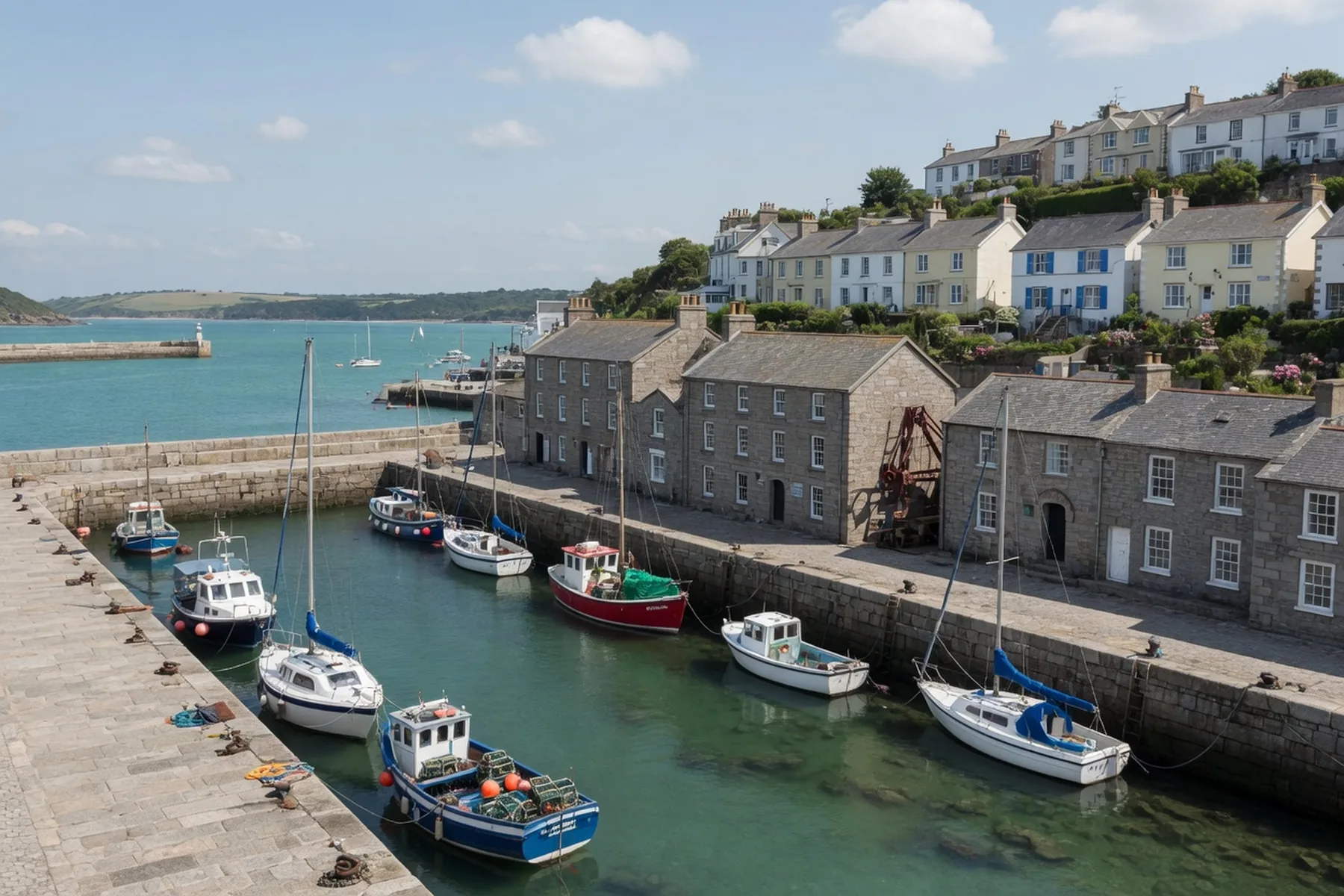
Falmouth is not an old fishing village that found tourism. It is a purpose-built port. Charles II granted the town its charter in 1661; the Post Office chose the harbour as a packet station in 1688; and for a century and a half after that, a large share of Britain’s overseas mail left from these quays. The streets, the captains’ houses and the museum are what that decision left behind.
You can spend a day here without noticing any of it, which is a waste. The harbour is still working. Reading it properly takes an hour on foot and a look inside the museum.
The Channel approach to London is long, and a sailing ship beating down it against a westerly could lose days. Falmouth sits at the first deep, sheltered water on that approach, tucked behind the Lizard. Mail for Spain, Portugal, the West Indies, the Americas and later the Mediterranean could be landed here and sent overland while the ship stayed out of the weather.
The Falmouth Packet Service ran from 1688 until 1851. At its height in the early nineteenth century some thirty-nine fast, lightly armed brigs sailed to seven stations — Lisbon and Corunna, the West Indies, Halifax and New York, Brazil and the River Plate, Gibraltar, Malta. They carried letters, bullion and passengers, and they relied on speed rather than guns. Captains took private cargo on the side; fortunes were made and lost on a single voyage.
The packets landed at Greenbank and at Custom House Quay. Flushing, directly across the Penryn River, housed crews and stores. The granite terrace of captains’ houses on the Flushing waterfront is the domestic face of the same trade, five minutes away by the ferry that still runs.
Falmouth became, in the phrase the town still likes, the information hub of the empire after London. News from the wars, from the plantations, from the Lisbon packets, came ashore here first.
Steam did not need Falmouth. A steamer could make Southampton or Liverpool on a schedule, without waiting on a westerly to clear the Channel. The Brazil and Madeira mails were withdrawn in 1850. The last scheduled packet, Seagull, came home in 1851. The Falmouth Packet newspaper kept the name; the ships did not.
The town’s answer was infrastructure. The Falmouth Docks Company formed in 1858; Viscount Falmouth laid the foundation stone on 28 February 1860; the first ship used the new docks in 1861. The Cornwall Railway reached Falmouth Docks in August 1863. The Falmouth Hotel — the town’s first purpose-built tourist hotel — opened in 1865 with its own beach. The packet port became a repair port and a resort at the same time, which is still the mixture you walk through.
The docks remain Cornwall’s largest. Three graving docks, more than two kilometres of wharf, ship repair and, since Pendennis Shipyard moved here in 1988, the building and refit of superyachts. Pendennis is not a visitor attraction and it does not need to be: you see the sheds from the headland and from the St Mawes ferry, and the workforce is one reason the town did not become a museum of itself.
The packet memorial. A granite obelisk above the Prince of Wales Pier: To the Memory of the Gallant Officers and Men of H M Post Office and Packet Service sailing from Falmouth 1688–1852. It is the right place to start a walk, because the pier is still where the boats leave.
Custom House Quay. The inner harbour, the old granite, the working boats. This is packet-era ground even when the boats in it are day-trippers and crabbers.
Greenbank. The older landing, now a hotel and a bar with one of the best harbour views in Cornwall. The water in front of it is the same roadstead the Lisbon packets used.
Arwenack Street, Market Street, Church Street. Laid out as the town’s commercial spine when Falmouth was new. The Killigrew monument — the granite needle that has been moved twice — sits near the pier and remembers the family who built the port.
National Maritime Museum Cornwall, on Discovery Quay, is where the story is told with objects. Its subject is small boats rather than liners, and the packet ships, the Falmouth gigs and the pilot cutters sit in that collection honestly. The Lookout Tower at the top is the best elevated view of the working docks short of Pendennis. Tickets usually convert to an annual pass; ask. See the museum page.
Pendennis Castle is the military half of the same geography: Henry VIII fortified the mouth because the anchorage was valuable. The castle and the packets are one harbour doing two jobs. See our Pendennis guide.
The St Mawes ferry is the cheap way to see the docks, the castle and the Roads in a single twenty minutes. Sit on the right leaving Falmouth.
On any ordinary weekday you will see yachts, a working fishing boat, and something large in the docks — a survey vessel, a laid-up cargo ship, a yacht under build with the wrapping still on. Laid-up ships sometimes sit in the deep water of the King Harry reach upriver, which is why the boat to Truro is more interesting than a river cruise has any right to be.
The oyster fishery is the other working leftover. Falmouth Bay oysters are dredged under sail in winter, from October to March, under a byelaw that bans engines — the last commercial fishery in Europe still working that way. They appear on menus from autumn, and the Oyster Festival in October is when the town makes a weekend of it. See when to visit Falmouth.
None of this is staged. The town has students, shipwrights, skippers and visitors on the same pavement, which is why it stays open in January when much of the Cornish coast does not.
Start at the packet memorial. Walk Custom House Quay, then Arwenack Street as far as the museum. Climb the Lookout Tower. Continue toward the docks along the flat — you will not get into Pendennis Shipyard, and you do not need to — then either take the hill up to the castle or drop back to the Prince of Wales Pier and cross to Flushing for the captains’ terrace and a pint looking at the town you just walked.
That is two hours without the castle, four with it. It is the Falmouth that is not the beach.
Fast Post Office ships that carried overseas mail from this harbour between 1688 and 1851, to Spain, the West Indies, the Americas and the Mediterranean.
The first deep sheltered water at the mouth of the Channel, so sailing packets did not have to beat down to London against the westerlies.
Yes. Ship repair, superyacht building at Pendennis Shipyard, fishing, bunkering, and a winter oyster dredge under sail.
The granite obelisk by the pier, Custom House Quay, and the National Maritime Museum. The St Mawes ferry shows you the docks from the water.
Not as a tourist site. You see them from the headland, from the ferry and from the museum tower.