Pendennis Castle — Kastel Penndinas in Cornish — stands on the headland at the eastern edge of Falmouth, and it is the most complete example in England of a fortification that stayed in continuous military use from the Tudors to the Cold War.
Henry VIII built it between 1540 and 1542 as part of the Device programme, the chain of coastal artillery forts thrown up when the king’s break with Rome left England expecting an invasion from France and the Holy Roman Empire. Pendennis and St Mawes on the opposite shore were built together to cover the Carrick Roads, the deep-water anchorage at the mouth of the River Fal — one of the finest natural harbours in the world, and the reason Falmouth exists.
The keep — a squat circular gun tower with a forebuilding and a gun platform below, designed to take heavy artillery firing at ships rather than to resist assault by land. This is the Tudor core.
The ramparts — at the end of the sixteenth century, with the Spanish threat sharpening after the Armada, the castle was wrapped in a ring of stone ramparts and angular bastions in the Italian manner. This is what gives Pendennis its size and what makes it feel like a fortress rather than a tower.
The Civil War. In 1646 Pendennis was one of the last two Royalist strongholds in England. Its garrison, under the octogenarian Sir John Arundell, held out for five months against siege by land and blockade by sea, and surrendered only when the food ran out — marching out with colours flying by the terms of the surrender. Only Raglan held longer.
The nineteenth and twentieth centuries. New batteries, a Victorian barracks, and coastal guns manned through both world wars. The Half Moon Battery was operational until 1956, which makes over four hundred years of unbroken service.
The keep, with its Tudor gun deck and displays of arms and armour; the guardhouse with its cells; the Royal Artillery barracks; the Half Moon Battery with its First World War guns; and a Second World War underground command post that visitors find the most atmospheric part of the site.
The interpretation is unusually good and visitors say so repeatedly — there is more to read, more to go into and more layers to it than at most castles of this size.
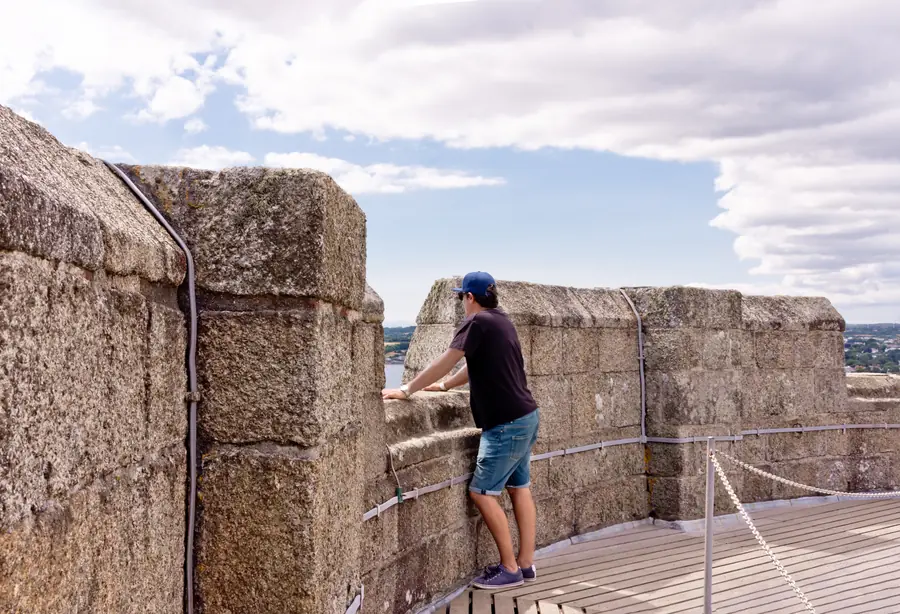
The views are the other half: the whole of Carrick Roads, St Mawes on the far shore, the docks, the town, and open Channel to the south.
Allow two to three hours.
Admission charged; free to English Heritage members. Book online in advance in summer.
Facilities: café, shop, toilets. Events, re-enactments and open-air theatre through the season.
Access: the site is large and partly on slopes; the keep and battery involve stairs.
Getting there: a twenty-five-minute uphill walk from the town centre, or by road with parking on site. Falmouth Docks station is the nearest, at the foot of the hill.
Pendennis Point, below the castle, with the old battery and free parking.
St Mawes Castle, the twin fort, reached by the St Mawes ferry from Prince of Wales Pier — the best way to see both in a day.
Castle Beach is at the bottom of the headland.
Henry VIII, between 1540 and 1542, as part of the Device programme of coastal artillery forts.
Pendennis held out for five months in 1646 as one of the last two Royalist strongholds in England, surrendering only when the food ran out.
Two to three hours — it is larger and has more to go into than most castles this size.
A twenty-five-minute uphill walk, or by road with parking on site.
Yes — the passenger ferry from Prince of Wales Pier crosses to St Mawes, and the two forts were built as a pair.