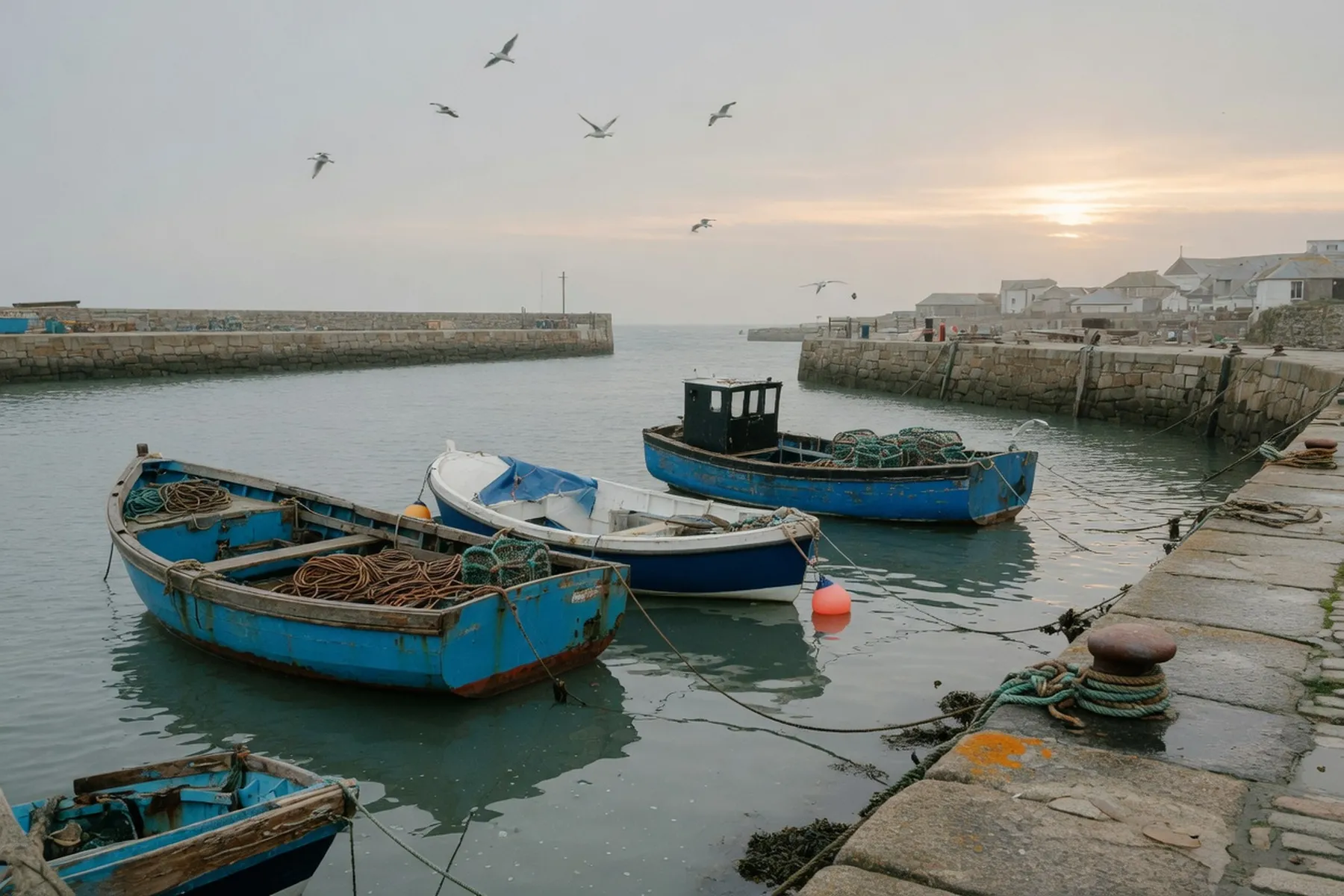
National Maritime Museum Cornwall stands on Discovery Quay in a green-oak building whose shape borrows from the boatbuilders’ sheds that once lined this water. Inside are fifteen galleries over five floors, most of them gathered around one theme: the small boats that ordinary people made, worked and survived in. It opens every day from 10:00 to 17:00, closing only on Christmas Eve, Christmas Day and Boxing Day, and the museum’s own guidance is to allow at least 1.5 to 3 hours for your visit.
The museum occupies the corner of the harbour where the town meets the water, at Discovery Quay, Falmouth, TR11 3QY, and the phone is 01326 313388. Follow the brown anchor signs off the A39. Its collection is the National Small Boat Collection, and the building was designed to read as a row of boatbuilding sheds in green oak rather than as a single civic block. Most of the fifteen galleries stay on the small-boat theme, but the museum reaches further: Cornwall’s relationship with the sea, the rescue services, and two floors of it that sit below sea level.
The centre of the building is a four-storey hall hung with small boats, a flotilla you can walk around at several levels rather than look up at from one floor. The boats are there because of what happened in them. The Ednamair is the dinghy in which the Robertson family, five people and a friend, survived 38 days in the Pacific after their yacht was holed and sunk. An Inuit kayak and a Mirror dinghy hang nearby; the museum describes the Mirror as “as much a part of the ’60s social revolution as the Mini car”. The theme throughout is boats shaped by the people who made and used them, and at the Boat Pool you can steer a remote-controlled model across the water.
Away from the hall, the galleries work through Cornwall’s maritime life. Cornwall & the Sea looks at the county’s relationship with the ocean, and the Cornish Quayside reconstructs a pilchard cellar, the industry that once salted fish here by the thousand. The RNLI Rescue Zone is the hands-on corner, with vehicles to hop on, dressing-up and sea-safety tips, and Skull Island is the pirate play zone for younger children. In the Boatbuilding Gallery and Workshop a team of volunteers, on site Tuesday to Thursday, is currently rebuilding a Helford surfboat of the kind used by the Special Operations Executive in the Second World War.
Admission covers the climb to the top of the 100 ft Lookout Tower. From the top you look out over Falmouth harbour, the docks and the estuary, with binoculars and telescopes to hand and maps that name the historic buildings, landmarks and vessels you can see, plus a live harbour webcam. Look north toward Flushing, once home to the Packet Ship captains, and west to Custom House Quay, where customs men landed the contraband they had seized.
The tower is usually reached by lift as well as stairs, but the museum has posted a notice that matters to anyone planning a visit with a wheelchair or a pushchair. The Tower Lift is out of operation in September 2026, a technical issue, which means the Tidal Zone and the Lookout are not currently accessible to wheelchair users or pushchairs, and the tower itself is reached by stairs while the lift is out. The rest of the museum, five levels, is normally served by lift and ramps. Check the museum’s accessibility page before you come if stairs are a problem, because the notice is dated and the lift may have been fixed since.
Two floors of the museum sit below sea level, and two large windows there open onto Falmouth Harbour itself. You watch the tide rise and fall against the glass, and the life that goes past it: diving cormorants, crabs, shrimps, occasionally a seal. The displays explain how the moon and the sun make the tides, and the estuary is described as a Special Conservation Area for the species it holds. Outside the windows hangs SeaHive, an artificial reef of recycled fishing gear, seven hexagonal tubes the museum describes as underwater beehives. Around you are the installations made from what has been pulled out of Cornish water: “Whale in the Room”, 380 kg of marine debris collected by Clean Ocean Sailing; “A Lesson from History”, ocean plastic shaped like the moai of Easter Island; and the “Bottle Top Chain”, more than 65,000 bottle tops gathered by the Cornish Plastic Pollution Coalition. Try to time your visit for high tide, when the windows show the harbour at its fullest.
Prices, from the museum’s ticket page on 23 September 2026: an adult is £19, a student £12, and a child under 18 is £10, with under-fives free. The standard admission is an Annual Pass, which means you pay once and it stays valid for twelve months, and that changes the arithmetic if you are local or coming back in the same year. A Twilight ticket, single visit from 3pm with no pass, is £12 for an adult and £6 for a child, under-fives free, and it can be upgraded to an Annual Pass on the day of the visit only. Pre-booking an adult or child ticket online before the day saves 10 per cent, and the same 10 per cent goes to Blue Light Card, HM Armed Forces ID and Veteran Card holders, on the cardholder’s ticket only. Carers go free with proof of need, and groups of ten or more have separate rates. Children under 16 must be accompanied by an adult, and you book at tickets.nmmc.co.uk. The figures move, so read the prices page before you travel.
The museum’s own answer is 1.5 to 3 hours, and the car parks around it reward you for knowing that figure. The nearest, Maritime Car Park, is pay-on-exit with a maximum stay of 4 hours, which is tight if you plan three hours inside plus lunch. Grove Place allows 3 hours. If you want to make a day of it, use The Dell car park about 200 m away, which is for longer stays; there are more than 400 short-term spaces within 150 m. The Maritime Car Park runs on an ANPR system and has a 2.2 m height restriction.
The museum is a five-minute walk from Falmouth Town station, sometimes shown as Falmouth The Dell; you change at Truro for the branch line. The buses that serve it are the U1, U1A, U1E, U1X, U2, U3, U4, U4X, M104, 660, 890 and 900, and you should check the timetable rather than trust a single route number, because the services change with the season. The St Mawes Ferry and the Truro river boat, both run by Fal River Cornwall, land within walking distance, and there are bike racks on site. Coaches drop on Cambeltown Way or Marine Crescent, and the nearest airport is Cornwall Airport Newquay. The wider choice of boats is covered in boat trips and ferries.
This is the museum’s quiet strength, and the reason it heads every wet-weather list for Falmouth. Fifteen indoor galleries, a café and a gift shop under one roof, ten minutes from the middle of town, make it the natural centrepiece of a day when the beaches are off. The café and gift shop keep their own hours, which you can check on the opening times page, and the shop is free to enter if you only want a dry corner and a look at the models. For the rest of a wet day, the companion piece is Falmouth in the rain.
SURF! — 100 years of waveriding in Cornwall runs in The Hold from 28 March 2025 until January 2027, and the companion Surfing Memories community exhibition hangs in the Balcony Gallery over the same span. The Pop-Up Family Discovery Zone is in The Bridge Gallery from 24 July to Sunday 1 November 2026. The Beattie Medals display, with Captain Stephen Beattie’s Victoria Cross and a fundraising drive for a display case, runs Monday 14 September to Monday 19 October. October half-term brings “Nautical Nasties” from Saturday 24 October to Sunday 1 November, with Make & Take sessions daily from 12.30 to 3.30pm, a Peculiar Portrait Trail, and The Haunted Bookshop with Coppice Theatre on Monday 26 to Friday 30 October at 11am, 1pm and 3pm; Halloween at the Museum follows after hours on Friday 31 October. The Autumn Lecture Series “Cornwall at War” runs in the Sunley Lecture Theatre at 7.30pm: Elizabeth Dale on Thursday 22 October (£8, £5 concession, £7.20 members, £6 online), and Bob White with Jonathan Griffin on Thursday 26 November. Nadelik: A Christmas Show plays Sunday 20 to Wednesday 23 December at 11am and 2pm. These dates are the museum’s and events do move, so check the museum’s what’s-on page before you book.
The entrance is level-access, with accessible toilets on the 1st and 2nd floors, a self-propelled wheelchair to borrow, assistance dogs welcome, large-print maps, subtitles on the AV exhibits and hearing loops. There are sensory bags, ear defenders and a Quiet Space in the Sunley Lecture Theatre, and the quietest times are weekday afternoons in term time. Carers go free with proof of need, such as an Access Card, DLA or PIP letter, and Access4ALL cardholders enter free. There is no Changing Places toilet in the building; the nearest is 0.1 mile away at Grove Place Public Toilets. The museum opens daily 10:00 to 17:00, closed on Christmas Eve, Christmas Day and Boxing Day.